Crab Nebula (M1)
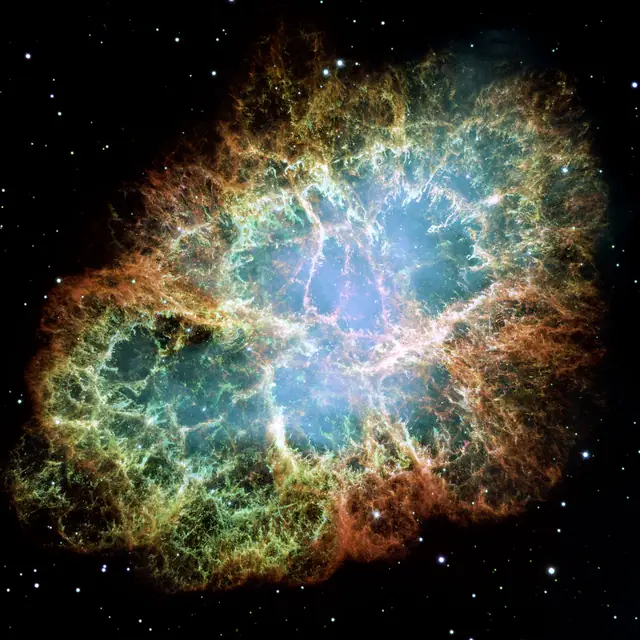
A supernova remnant from a star that exploded in 1054 AD. It requires a telescope to be seen as a patch of light.
Supernova remnant in Taurus. Magnitude 8.4.
Can you see it from Guyana?
From Georgetown (6.8° N) it climbs to 75° above the northern horizon at its highest; from Lethem (3.4° N), to 71° above the northern horizon. It is highest at midnight on the night of 12 Dec, in the middle of its season. The page works out tonight's rise, highest point and set for both towns in Guyana time (UTC-4), and where the Moon is.
What you'll see
- Your eyes: Not visible to the eye.
- 10x50 binoculars: A faint smudge from a dark site.
- A small telescope (80 to 100 mm): A faint oval glow; its detail needs a larger telescope.
- A camera: Tiny on camera: it needs 2,000 mm or more of focal length on a tracking mount. An H-alpha-sensitive (modified) camera brings out its red glow.
How big, how bright, how far
- Size on the sky: 6′ × 4′, 19% of the Moon's width (the Moon is about 31′ wide).
- Brightness: magnitude 8.4. Fainter than the faintest stars in Georgetown (4.3) and Lethem (6.0): binoculars or a telescope.
- Distance: 6,500 light-years. The light reaching your eye left it about 6,500 years ago.
What it is made of
- Type
- Supernova Remnant
- Distance
- Approx. 6,500 Lightyears
- True size
- Approx. 11 Lightyears diameter
- Ionized Hydrogen (HII): Ejected stellar material
- Helium, Oxygen, Sulfur: Layers from progenitor star
- Neutron Star: Crab Pulsar at center
More deep-sky objects: Veil Nebula (NGC 6960, 6992, etc.) · Open Cluster M35 · Open Cluster M37 · Open Cluster M36 · Open Cluster M38 · Hyades Cluster