M103 (Open Cluster)
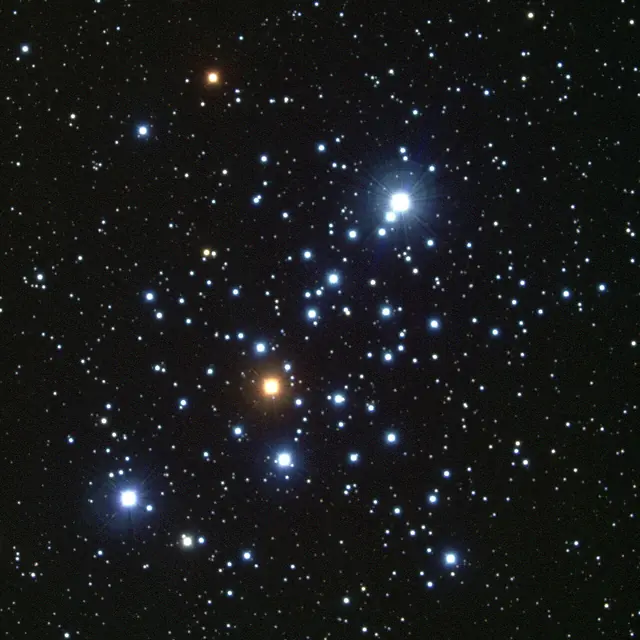
A compact open cluster in Cassiopeia, one of the most distant Messier open clusters. A small but distinct fan-shaped patch in binoculars and small telescopes.
Open cluster in Cassiopeia. Magnitude 7.4.
Can you see it from Guyana?
From Georgetown (6.8° N) it climbs to 36° above the northern horizon at its highest; from Lethem (3.4° N), to 33° above the northern horizon. It is highest at midnight on the night of 12 Oct, in the middle of its season. The page works out tonight's rise, highest point and set for both towns in Guyana time (UTC-4), and where the Moon is.
What you'll see
- Your eyes: Not visible to the eye.
- 10x50 binoculars: A small hazy knot with a few stars resolved.
- A small telescope (80 to 100 mm): Dozens to hundreds of stars at low power.
- A camera: Tiny on camera: it needs 2,000 mm or more of focal length on a tracking mount.
How big, how bright, how far
- Size on the sky: 6′, 19% of the Moon's width (the Moon is about 31′ wide).
- Brightness: magnitude 7.4. Fainter than the faintest stars in Georgetown (4.3) and Lethem (6.0): binoculars or a telescope.
- Distance: 8,240 light-years. The light reaching your eye left it about 8,200 years ago.
What it is made of
- Type
- Open cluster
- Distance
- Approx. 8,240 Lightyears
- True size
- Approx. 14 Lightyears across
- Age
- about 47 million years (range 28 million years to 67 million years)
- Notable
- A young, distant cluster: about 47 million years old and 8,240 light-years away.
.jpg)
More deep-sky objects: NGC 457 (ET Cluster / Owl Cluster) · Double Cluster (NGC 869 & NGC 884) · NGC 7789 (Caroline's Rose / White Rose Cluster) · Kemble's Cascade & NGC 1502 · Alpha Persei Cluster (Melotte 20) · NGC 752 (Open Cluster)