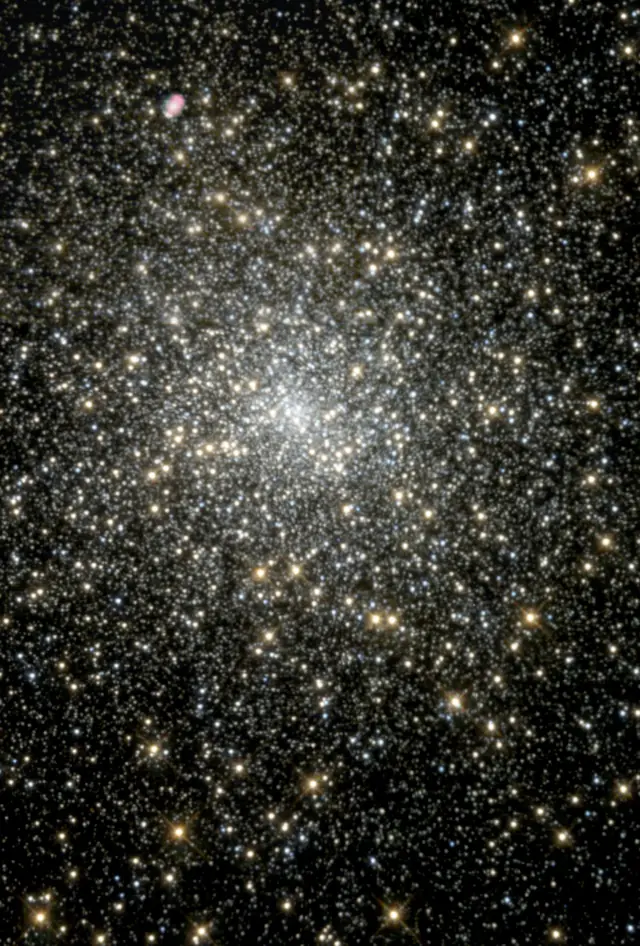
Globular Cluster M15
A bright and dense globular cluster in Pegasus, notable for being one of the oldest known globulars and containing a rare planetary nebula, Pease 1. Visible with binoculars as a fuzzy star.
Globular cluster in Pegasus. Magnitude 6.2.
Can you see it from Guyana?
From Georgetown (6.8° N) it climbs to 85° above the northern horizon at its highest; from Lethem (3.4° N), to 81° above the northern horizon. It is highest at midnight on the night of 11 Aug, in the middle of its season. The page works out tonight's rise, highest point and set for both towns in Guyana time (UTC-4), and where the Moon is.
What you'll see
- Your eyes: Not visible to the eye.
- 10x50 binoculars: A round glow, brighter towards the middle.
- A small telescope (80 to 100 mm): A round, bright glow; its stars need a larger telescope to resolve.
- A camera: Tiny on camera: it needs 2,000 mm or more of focal length on a tracking mount.
How big, how bright, how far
- Size on the sky: 12′, 39% of the Moon's width (the Moon is about 31′ wide).
- Brightness: magnitude 6.2. Fainter than the faintest stars in Georgetown (4.3) and Lethem (6.0): binoculars or a telescope.
- Distance: 34,900 light-years. The light reaching your eye left it about 35,000 years ago.
What it is made of
- Type
- Globular Cluster
- Distance
- Approx. 34,900 Lightyears
- True size
- Approx. 120 Lightyears across (visible extent)
- Notable
- One of the densest globulars: its core has collapsed (flagged "c" in the Harris catalogue, one of 31), and its stars are among the most metal-poor ([Fe/H] -2.22).
- Old Stars (Hundreds of Thousands): Population II, metal-poor, very dense core
- Pease 1 (Planetary Nebula): One of few known planetary nebulae in a globular cluster
- Minimal Gas and Dust: Most material consumed in early star formation
More deep-sky objects: M2 (Globular Cluster) · Wild Duck Cluster (M11) · M55 (Globular Cluster) · NGC 7789 (Caroline's Rose / White Rose Cluster) · M25 (Open Cluster IC 4725) · Eagle Nebula (M16)