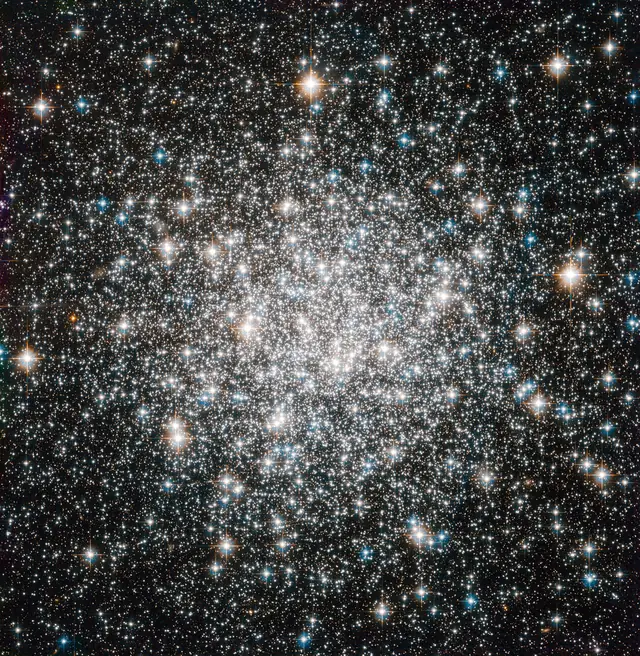
Globular Cluster M22
One of the brightest globular clusters visible in the night sky, located in Sagittarius. Visible to the naked eye in very dark conditions, and a fine sight in binoculars.
Globular cluster in Sagittarius. Magnitude 5.1.
Can you see it from Guyana?
From Georgetown (6.8° N) it climbs to 59° above the southern horizon at its highest; from Lethem (3.4° N), to 63° above the southern horizon. It is highest at midnight on the night of 28 Jun, in the middle of its season. The page works out tonight's rise, highest point and set for both towns in Guyana time (UTC-4), and where the Moon is.
What you'll see
- Your eyes: Visible to the eye only from a dark site, as a fuzzy star; lost in city skies.
- 10x50 binoculars: A round glow, brighter towards the middle.
- A small telescope (80 to 100 mm): A small telescope resolves many of its stars; one of the best globulars in the sky.
- A camera: Spans about 40% of an APS-C frame at 1,500 mm (field 0.9° × 0.6°); needs a tracking mount.
How big, how bright, how far
- Size on the sky: 24′, 77% of the Moon's width (the Moon is about 31′ wide).
- Brightness: magnitude 5.1. Fainter than Georgetown's faintest stars (4.3) but brighter than Lethem's (6.0).
- Distance: 10,600 light-years. The light reaching your eye left it about 11,000 years ago.
What it is made of
- Type
- Globular Cluster
- Distance
- Approx. 10,600 Lightyears
- True size
- Approx. 100 Lightyears diameter
- Old Stars (Hundreds of Thousands): Elliptical shape, relatively metal-rich for a globular
- Planetary Nebula (IRAS 18333-2357): Rare find within a globular cluster
More deep-sky objects: M25 (Open Cluster IC 4725) · Eagle Nebula (M16) · Ptolemy Cluster (M7) · Butterfly Cluster (M6) · M55 (Globular Cluster) · Wild Duck Cluster (M11)