Ring Nebula (M57)
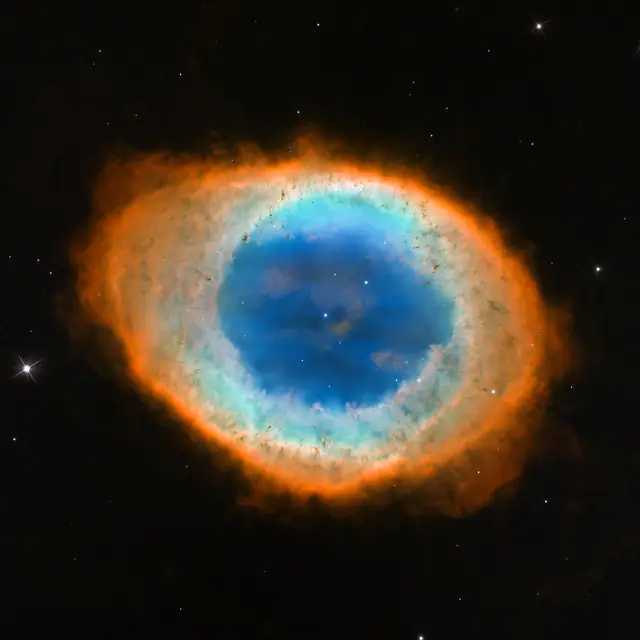
A famous planetary nebula whose ring shape is best seen with a telescope.
Planetary nebula in Lyra. Magnitude 8.8.
Can you see it from Guyana?
From Georgetown (6.8° N) it climbs to 64° above the northern horizon at its highest; from Lethem (3.4° N), to 60° above the northern horizon. It is highest at midnight on the night of 3 Jul, in the middle of its season. The page works out tonight's rise, highest point and set for both towns in Guyana time (UTC-4), and where the Moon is.
What you'll see
- Your eyes: Not visible to the eye.
- 10x50 binoculars: Looks like a faint star; it needs a telescope.
- A small telescope (80 to 100 mm): A clear disc or ring at medium power; an OIII filter helps.
- A camera: Tiny on camera: it needs 2,000 mm or more of focal length on a tracking mount.
How big, how bright, how far
- Size on the sky: 1′, 1/31 of the Moon's width (the Moon is about 31′ wide).
- Brightness: magnitude 8.8. Fainter than the faintest stars in Georgetown (4.3) and Lethem (6.0): binoculars or a telescope.
- Distance: 2,300 light-years. The light reaching your eye left it about 2,300 years ago.
What it is made of
- Type
- Planetary Nebula
- Distance
- Approx. 2,300 Lightyears
- True size
- Approx. 2.5 Lightyears diameter
- Ionized Oxygen (OIII): Emits strong green/blue light, forms the main ring structure
- Ionized Hydrogen (H-alpha): Emits red light, prominent in the outer regions
- Central White Dwarf: Hot, dense remnant of the progenitor star, ionizes the nebula
- Helium and Nitrogen Ions: Contribute to various emission lines and colors
More deep-sky objects: Dumbbell Nebula (M27) · Cat's Eye Nebula (NGC 6543) · Blue Snowball Nebula (NGC 7662) · Saturn Nebula (NGC 7009) · Little Dumbbell Nebula (M76) · Helix Nebula (NGC 7293)