M84 (Galaxy)
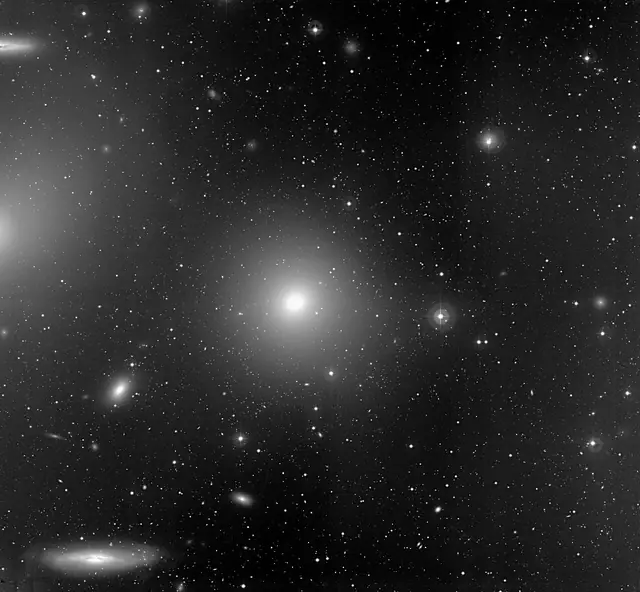
A round elliptical galaxy near the heart of the Virgo Cluster. M86 is only 0.28° to the east, so the two always share a field, and M87 is 1.5° away.
Galaxy in Virgo. Magnitude 9.8.
Can you see it from Guyana?
From Georgetown (6.8° N) it climbs to 84° above the northern horizon at its highest; from Lethem (3.4° N), to 81° above the northern horizon. It is highest at midnight on the night of 26 Mar, in the middle of its season. The page works out tonight's rise, highest point and set for both towns in Guyana time (UTC-4), and where the Moon is.
What you'll see
- Your eyes: Not visible to the eye. It lies 8.9° east of Denebola.
- 10x50 binoculars: Just detectable in binoculars from a dark site, as a faint smudge. M86 is 0.28° away in the same field.
- A small telescope (80 to 100 mm): A round glow with a bright centre, with M86 0.28° to the east in the same low-power field.
- A camera: Tiny on camera: it needs 2,000 mm or more of focal length on a tracking mount. At 1,000 mm it shares the frame with M86.
How big, how bright, how far
- Size on the sky: 7.4′ × 6.4′, 24% of the Moon's width (the Moon is about 31′ wide).
- Brightness: magnitude 9.8. Fainter than the faintest stars in Georgetown (4.3) and Lethem (6.0): binoculars or a telescope.
- Distance: 60 million light-years. The light reaching your eye left it about 60 million years ago.
- True size: 120,000 light-years across its catalogued outline; light crosses it in 120,000 years.
Apparent size from OpenNGC (Mattia Verga), CC-BY-SA-4.0.
What it is made of
- Type
- Elliptical galaxy
- Notable
- The large elliptical at the centre of its field; the edge-on active spiral NGC 4388 sits nearby.
What is in it, not measured:
- Old stars: mostly old, yellow and red
- Very little cold gas or dust
- Dark matter: inferred from how its stars move
How we know: Distance from the median of 62 published estimates by several methods (no two direct ones agree to combine): NED-D (NASA/IPAC Extragalactic Database, redshift-independent distances), median of 62 estimates: 17.05 Mpc, 14.86-18.80 Mpc (16th-84th percentile); e.g. 2013AJ....146...86T, 2012ApJ...749..174C, 2011A&A...532A.154C; retrieved 2026-10-21. True size: the apparent size times the distance (apparent size: OpenNGC (Mattia Verga, CC BY-SA 4.0), commit 4e2398a2).
More deep-sky objects: M86 (Galaxy) · Virgo Galaxy (M87) · M88 (Galaxy) · Coma Pinwheel (M99) · M89 (Galaxy) · M90 (Galaxy)