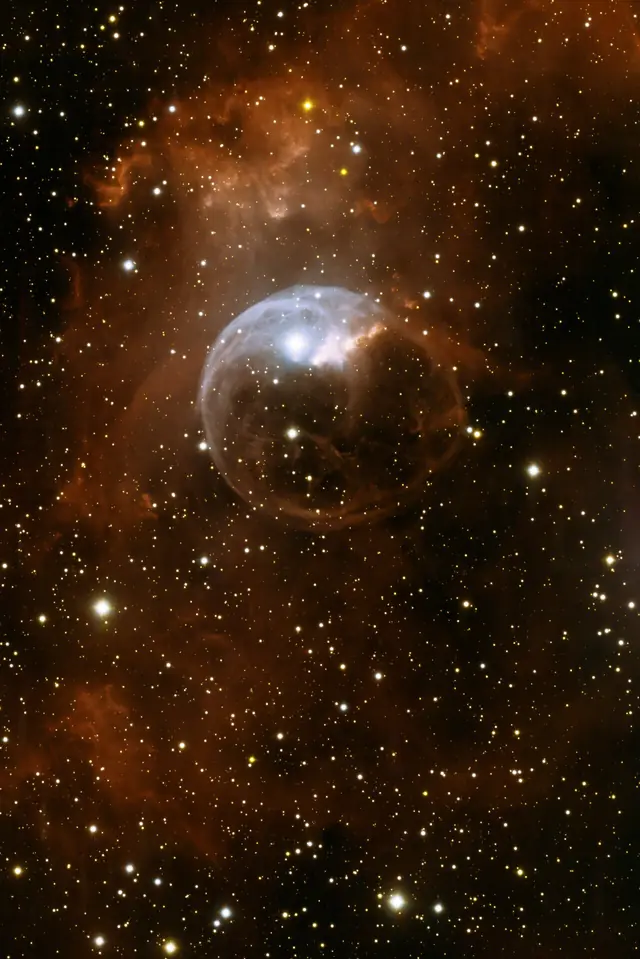
Bubble Nebula (NGC 7635)
A bubble of gas in Cassiopeia, blown by the wind of BD+60 2522, a hot, massive star. Gaia measures the star at about 9,800 light-years; the open cluster M52 is 0.6° away.
Emission nebula in Cassiopeia.
Can you see it from Guyana?
From Georgetown (6.8° N) it climbs to 35° above the northern horizon at its highest; from Lethem (3.4° N), to 32° above the northern horizon. It is highest at midnight on the night of 8 Sep, in the middle of its season. The page works out tonight's rise, highest point and set for both towns in Guyana time (UTC-4), and where the Moon is.
What you'll see
- Your eyes: Not visible to the eye. It lies 6.3° north-west of Caph.
- 10x50 binoculars: Not visible in binoculars; the open cluster M52 shows 0.6° away.
- A small telescope (80 to 100 mm): Very hard: with a UHC or OIII filter, a faint glow around the star; the bubble itself is a camera target.
- A camera: Spans about 40% of an APS-C frame at 2,000 mm (field 0.7° × 0.4°); needs a tracking mount. An H-alpha-sensitive (modified) camera brings out its red glow. M52 is in the same frame.
How big, how bright, how far
- Size on the sky: 15′ × 8′, 48% of the Moon's width (the Moon is about 31′ wide).
- Distance: 9,800 light-years. The light reaching your eye left it about 9,800 years ago.
- True size: 43 light-years across its catalogued outline; light crosses it in 43 years.
Apparent size from OpenNGC (Mattia Verga), CC-BY-SA-4.0.
What it is made of
- Type
- Emission nebula blown by a star
What is in it, not measured:
- A bubble of gas: blown by the wind of a hot star
- Ionised hydrogen: glowing red around it
- The star BD+60 2522: which blows the bubble
How we know: Distance from the Gaia parallax of BD+60 2522, the star that blows the bubble: Gaia EDR3 parallax via SIMBAD (basic.plx_value, 2020yCat.1350....0G), distance = 1/parallax, retrieved 2026-10-21 (BD+60 2522: 0.3341 +/- 0.0152 mas). True size: the apparent size times the distance (apparent size: OpenNGC (Mattia Verga, CC BY-SA 4.0), commit 4e2398a2).
More deep-sky objects: Cave Nebula (Caldwell 9) · Pacman Nebula (NGC 281) · Blue Snowball Nebula (NGC 7662) · Little Dumbbell Nebula (M76) · Cat's Eye Nebula (NGC 6543) · Crescent Nebula (NGC 6888)