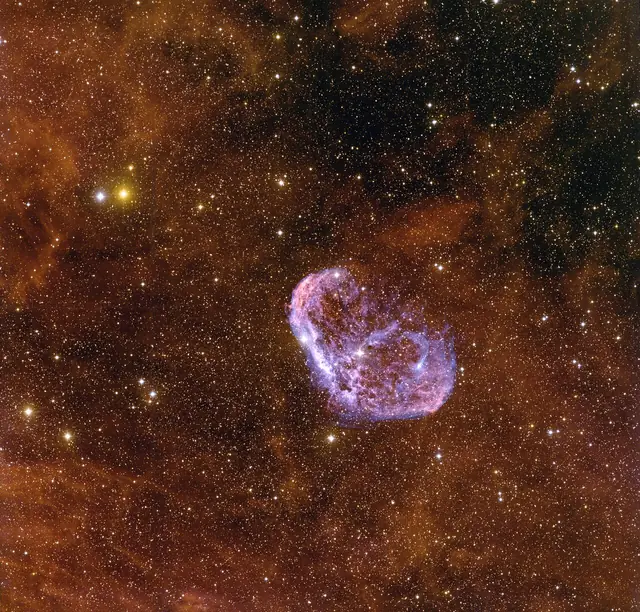
Crescent Nebula (NGC 6888)
A shell of gas in Cygnus blown by WR 136, a Wolf-Rayet star shedding its outer layers in a fierce wind. Gaia measures the star itself, at about 5,700 light-years.
Emission nebula in Cygnus.
Can you see it from Guyana?
From Georgetown (6.8° N) it climbs to 58° above the northern horizon at its highest; from Lethem (3.4° N), to 55° above the northern horizon. It is highest at midnight on the night of 22 Jul, in the middle of its season. The page works out tonight's rise, highest point and set for both towns in Guyana time (UTC-4), and where the Moon is.
What you'll see
- Your eyes: Not visible to the eye. It lies 2.7° south-west of Sadr.
- 10x50 binoculars: Not visible in binoculars.
- A small telescope (80 to 100 mm): With an OIII filter, a faint arc; without one it is very hard.
- A camera: Spans about 40% of an APS-C frame at 1,500 mm (field 0.9° × 0.6°); needs a tracking mount. An H-alpha-sensitive (modified) camera brings out its red glow.
How big, how bright, how far
- Size on the sky: 20′ × 10′, 64% of the Moon's width (the Moon is about 31′ wide).
- Distance: 5,700 light-years. The light reaching your eye left it about 5,700 years ago.
- True size: 33 light-years across its catalogued outline; light crosses it in 33 years.
Apparent size from OpenNGC (Mattia Verga), CC-BY-SA-4.0.
What it is made of
- Type
- Wind-blown nebula
What is in it, not measured:
- Gas thrown off by a massive star: in its fierce stellar wind
- Swept-up gas: from around the star
- The Wolf-Rayet star itself: hot, and losing mass fast
How we know: Distance from the Gaia parallax of WR 136, the Wolf-Rayet star that blows it: Gaia EDR3 parallax via SIMBAD (basic.plx_value, 2020yCat.1350....0G), distance = 1/parallax, retrieved 2026-10-21 (HD 192163: 0.5772 +/- 0.016 mas). True size: the apparent size times the distance (apparent size: OpenNGC (Mattia Verga, CC BY-SA 4.0), commit 4e2398a2).
More deep-sky objects: Dumbbell Nebula (M27) · Ring Nebula (M57) · Cat's Eye Nebula (NGC 6543) · Cave Nebula (Caldwell 9) · Blue Snowball Nebula (NGC 7662) · Bubble Nebula (NGC 7635)