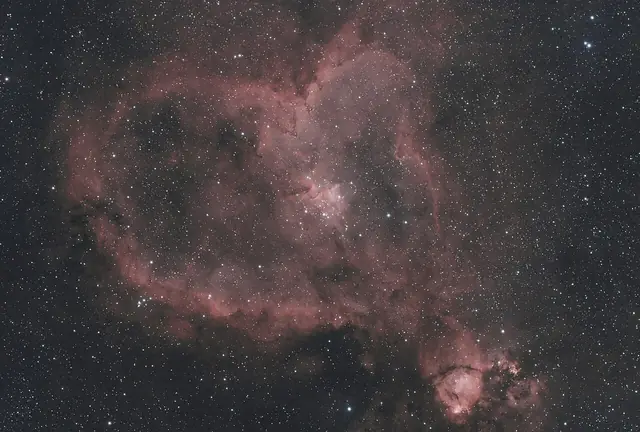
Heart Nebula (IC 1805)
A large glowing cloud in Cassiopeia, five Full Moons across, lit by IC 1805, a cluster only about 4 million years old. The Soul Nebula lies beside it at nearly the same distance.
Nebula and star cluster in Cassiopeia.
Can you see it from Guyana?
From Georgetown (6.8° N) it climbs to 35° above the northern horizon at its highest; from Lethem (3.4° N), to 32° above the northern horizon. It is highest at midnight on the night of 27 Oct, in the middle of its season. The page works out tonight's rise, highest point and set for both towns in Guyana time (UTC-4), and where the Moon is.
What you'll see
- Your eyes: Not visible to the eye. It lies 8.2° east of Ruchbah.
- 10x50 binoculars: The cluster at its centre shows; the nebula needs a filter and a dark site.
- A small telescope (80 to 100 mm): Too big for a telescope field; the central cluster shows, and its bright knots need a filter.
- A camera: Spans about 40% of an APS-C frame at 200 mm (field 6.7° × 4.5°); needs a tracking mount. An H-alpha-sensitive (modified) camera brings out its red glow.
How big, how bright, how far
- Size on the sky: 150′, 4.8 Moons across (the Moon is about 31′ wide).
- Distance: 6,600 light-years. The light reaching your eye left it about 6,600 years ago.
- True size: 290 light-years across its catalogued outline; light crosses it in 290 years.
What it is made of
- Type
- Emission nebula with a young cluster
- Mass
- About 1,700 times the Sun's mass, in the stars of its cluster IC 1805
- Age
- About 3.8 million years (range 2.8 million years to 4.7 million years), the age of IC 1805
What is in it, not measured:
- Ionised hydrogen: glows red where hot stars light it
- Helium and heavier gases: with traces of oxygen, nitrogen and sulphur
- Dust: in dark lanes
- Young hot stars: that light it
How we know: Distance from Gaia parallaxes of the stars of IC 1805, the cluster inside it: Hunt & Reffert 2024, A&A 686, A42 (Gaia DR3 cluster catalogue, VizieR J/A+A/686/A42), retrieved 2026-10-21: IC 1805 2,020 pc; statistical 6,567-6,607 ly (16th-84th percentile); Gaia DR3 parallax zero-point systematics (about 0.02 mas) add about 4%. True size: the apparent size times the distance (apparent size: Sharpless 1959, ApJS 4, 257 (VizieR VII/20), Sh2-190). Mass: Hunt & Reffert 2024, A&A 686, A42 (Gaia DR3 cluster catalogue, VizieR J/A+A/686/A42), retrieved 2026-10-21, IC 1805: total 1,704 ± 284 Suns.

More deep-sky objects: Soul Nebula (IC 1848) · Double Cluster (NGC 869 & NGC 884) · M103 (Open Cluster) · NGC 457 (ET Cluster / Owl Cluster) · Kemble's Cascade & NGC 1502 · Alpha Persei Cluster (Melotte 20)