M108 (Galaxy)
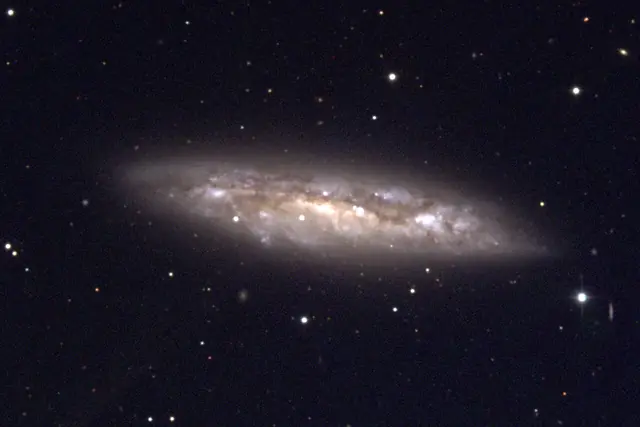
A spiral galaxy in Ursa Major seen almost edge-on, so its disc reads as a long streak. It sits 0.8° from the Owl Nebula, so one low-power sweep shows a galaxy and a planetary nebula together.
Galaxy in Ursa Major. Magnitude 10.1.
Can you see it from Guyana?
From Georgetown (6.8° N) it climbs to 41° above the northern horizon at its highest; from Lethem (3.4° N), to 38° above the northern horizon. It is highest at midnight on the night of 8 Mar, in the middle of its season. The page works out tonight's rise, highest point and set for both towns in Guyana time (UTC-4), and where the Moon is.
What you'll see
- Your eyes: Not visible to the eye. It lies 1.5° south-east of Merak.
- 10x50 binoculars: Just detectable in binoculars from a dark site, as a faint smudge. The Owl Nebula (M97) is 0.8° away.
- A small telescope (80 to 100 mm): A thin streak about 2.4 times as long as wide; the Owl Nebula (M97) is 0.8° away.
- A camera: Tiny on camera: it needs 2,000 mm or more of focal length on a tracking mount.
How big, how bright, how far
- Size on the sky: 4.0′ × 1.7′, 13% of the Moon's width (the Moon is about 31′ wide).
- Brightness: magnitude 10.1. Fainter than the faintest stars in Georgetown (4.3) and Lethem (6.0): binoculars or a telescope.
- Distance: 30 million light-years. The light reaching your eye left it about 30 million years ago.
- True size: 32,000 light-years across its catalogued outline; light crosses it in 32,000 years.
Apparent size from OpenNGC (Mattia Verga), CC-BY-SA-4.0.
What it is made of
- Type
- Spiral galaxy, seen nearly edge-on
What is in it, not measured:
- Stars: an older central bulge and a disc of younger stars
- Gas and dust: in the spiral arms, where new stars form
- Dark matter: inferred from how fast it spins
How we know: Distance from the median of 22 published estimates by several methods (no two direct ones agree to combine): NED-D (NASA/IPAC Extragalactic Database, redshift-independent distances), median of 22 estimates: 8.57 Mpc, 7.22-13.49 Mpc (16th-84th percentile); e.g. 2016AJ....152...50T, 2014MNRAS.444..527S, 2013AJ....146...86T; retrieved 2026-10-21. True size: the apparent size times the distance (apparent size: OpenNGC (Mattia Verga, CC BY-SA 4.0), commit 4e2398a2).
More deep-sky objects: M109 (Galaxy) · Galaxy M106 · Bode's Galaxy (M81) · Cigar Galaxy (M82) · M94 (Galaxy) · Whirlpool Galaxy (M51)