Galaxy M106
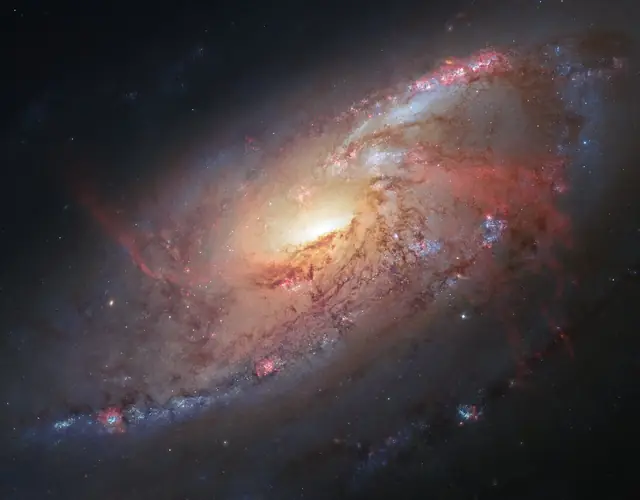
A prominent intermediate spiral galaxy in Canes Venatici. It has unusual 'anomalous arms' not aligned with its galactic plane. Visible as a smudge in binoculars, a telescope reveals more structure.
Galaxy in Canes Venatici. Magnitude 8.4.
Can you see it from Guyana?
From Georgetown (6.8° N) it climbs to 50° above the northern horizon at its highest; from Lethem (3.4° N), to 46° above the northern horizon. It is highest at midnight on the night of 25 Mar, in the middle of its season. The page works out tonight's rise, highest point and set for both towns in Guyana time (UTC-4), and where the Moon is.
What you'll see
- Your eyes: Not visible to the eye.
- 10x50 binoculars: A faint smudge from a dark site.
- A small telescope (80 to 100 mm): Faint and diffuse: use low power from a dark site.
- A camera: Spans about 40% of an APS-C frame at 2,000 mm (field 0.7° × 0.4°); needs a tracking mount.
How big, how bright, how far
- Size on the sky: 18′ × 8′, 58% of the Moon's width (the Moon is about 31′ wide).
- Brightness: magnitude 8.4. Fainter than the faintest stars in Georgetown (4.3) and Lethem (6.0): binoculars or a telescope.
- Distance: 24 million light-years. The light reaching your eye left it about 24 million years ago.
What it is made of
- Type
- Spiral Galaxy (Seyfert II)
- Distance
- Approx. 23.7 million Lightyears
- True size
- Approx. 135,000 Lightyears diameter
- Stars (Billions): Two main spiral arms, central bar
- Active Galactic Nucleus (AGN): Supermassive black hole accreting matter
- Anomalous Arms: Likely jets of plasma from AGN, not stellar arms
More deep-sky objects: Whirlpool Galaxy (M51) · Pinwheel Galaxy (M101) · Needle Galaxy (NGC 4565) · Black Eye Galaxy (M64) · Bode's Galaxy (M81) · Cigar Galaxy (M82)