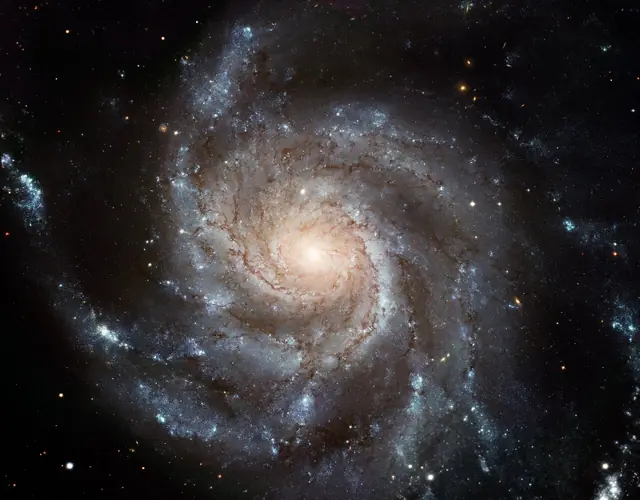
Pinwheel Galaxy (M101)
A large face-on spiral galaxy in Ursa Major. It has a low surface brightness, so dark skies and a telescope are best for viewing its spiral arms.
Galaxy in Ursa Major. Magnitude 7.9.
Can you see it from Guyana?
From Georgetown (6.8° N) it climbs to 43° above the northern horizon at its highest; from Lethem (3.4° N), to 39° above the northern horizon. It is highest at midnight on the night of 20 Apr, in the middle of its season. The page works out tonight's rise, highest point and set for both towns in Guyana time (UTC-4), and where the Moon is.
What you'll see
- Your eyes: Not visible to the eye.
- 10x50 binoculars: Just detectable in binoculars from a dark site, as a faint smudge.
- A small telescope (80 to 100 mm): Faint and diffuse: use low power from a dark site.
- A camera: Spans about 40% of an APS-C frame at 1,000 mm (field 1.3° × 0.9°); needs a tracking mount.
How big, how bright, how far
- Size on the sky: 27′, 87% of the Moon's width (the Moon is about 31′ wide).
- Brightness: magnitude 7.9. Fainter than the faintest stars in Georgetown (4.3) and Lethem (6.0): binoculars or a telescope.
- Distance: 21 million light-years. The light reaching your eye left it about 21 million years ago.
What it is made of
- Type
- Galaxy
- Distance
- Approx. 21 million Lightyears
- True size
- Approx. 170,000 Lightyears diameter
- Spiral Arms: Bright star-forming regions
- Core/Bulge: Older star population
- Dark Matter Halo: Accounted for by gravitational effects
More deep-sky objects: Whirlpool Galaxy (M51) · Galaxy M106 · Cigar Galaxy (M82) · Bode's Galaxy (M81) · Needle Galaxy (NGC 4565) · Black Eye Galaxy (M64)