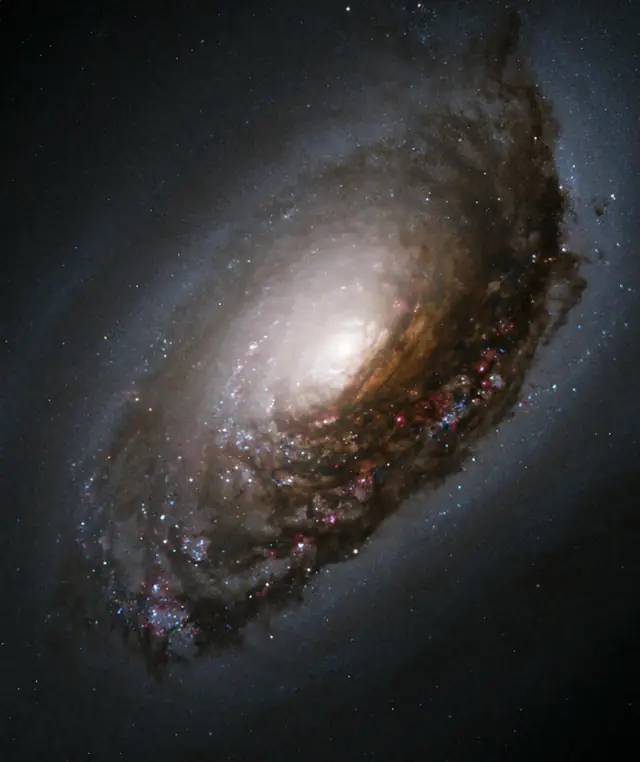
Black Eye Galaxy (M64)
A spiral galaxy in Coma Berenices, known for a spectacular dark band of absorbing dust in front of the galaxy's bright nucleus, requiring a telescope to see clearly.
Galaxy in Coma Berenices. Magnitude 8.5.
Can you see it from Guyana?
From Georgetown (6.8° N) it climbs to 75° above the northern horizon at its highest; from Lethem (3.4° N), to 72° above the northern horizon. It is highest at midnight on the night of 2 Apr, in the middle of its season. The page works out tonight's rise, highest point and set for both towns in Guyana time (UTC-4), and where the Moon is.
What you'll see
- Your eyes: Not visible to the eye.
- 10x50 binoculars: A faint smudge from a dark site.
- A small telescope (80 to 100 mm): A bright core in an oval halo; spiral structure needs a larger telescope.
- A camera: Tiny on camera: it needs 2,000 mm or more of focal length on a tracking mount.
How big, how bright, how far
- Size on the sky: 9′ × 5′, 29% of the Moon's width (the Moon is about 31′ wide).
- Brightness: magnitude 8.5. Fainter than the faintest stars in Georgetown (4.3) and Lethem (6.0): binoculars or a telescope.
- Distance: 17 million light-years. The light reaching your eye left it about 17 million years ago.
What it is made of
- Type
- Spiral Galaxy
- Distance
- Approx. 17 million Lightyears
- True size
- Approx. 54,000 Lightyears diameter
- Stars (Billions): Bright core and spiral arms
- Dark Dust Band: Spectacular absorbing band of dust, gives its name
- Counter-rotating Gas Systems: Suggests a past merger event
More deep-sky objects: Needle Galaxy (NGC 4565) · Galaxy M106 · Whirlpool Galaxy (M51) · Sombrero Galaxy (M104) · Pinwheel Galaxy (M101) · Southern Pinwheel Galaxy (M83)