Southern Pinwheel Galaxy (M83)
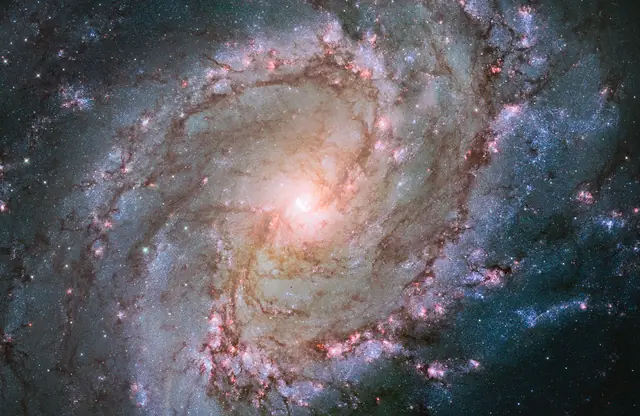
A bright barred spiral galaxy in Hydra, also known as the Southern Pinwheel. One of the closest and brightest barred spirals, a prominent galaxy for southern observers, best viewed with a telescope to see its arms.
Galaxy in Hydra. Magnitude 7.5.
Can you see it from Guyana?
From Georgetown (6.8° N) it climbs to 53° above the southern horizon at its highest; from Lethem (3.4° N), to 57° above the southern horizon. It is highest at midnight on the night of 13 Apr, in the middle of its season. The page works out tonight's rise, highest point and set for both towns in Guyana time (UTC-4), and where the Moon is.
What you'll see
- Your eyes: Not visible to the eye.
- 10x50 binoculars: A faint smudge from a dark site.
- A small telescope (80 to 100 mm): A bright core in an oval halo; spiral structure needs a larger telescope.
- A camera: Tiny on camera: it needs 2,000 mm or more of focal length on a tracking mount.
How big, how bright, how far
- Size on the sky: 11′ × 10′, 35% of the Moon's width (the Moon is about 31′ wide).
- Brightness: magnitude 7.5. Fainter than the faintest stars in Georgetown (4.3) and Lethem (6.0): binoculars or a telescope.
- Distance: 16 million light-years. The light reaching your eye left it about 16 million years ago.
- True size: 51,000 light-years across its catalogued outline; light crosses it in 51,000 years.
What it is made of
- Type
- Barred Spiral Galaxy
What is in it, not measured:
- Stars: Bright nucleus, well-defined spiral arms
- HII Regions: Numerous bright pink star-forming regions
- Dust Lanes: Trace the spiral structure
How we know: Distance from its brightest red giants (the tip of the red giant branch): NED-D TRGB 4.80 Mpc (Radburn-Smith et al. 2011) and 4.92 Mpc (Jacobs et al. 2009), mean 4.86 Mpc, retrieved 2026-10-21. True size: the apparent size times the distance (apparent size: HEASARC messier table (Sky Catalogue 2000.0, Hirshfeld & Sinnott 1985), via HEASARC TAP 2026-10-02 (M83)).
More deep-sky objects: Centaurus A (NGC 5128) · Sombrero Galaxy (M104) · Antennae Galaxies (NGC 4038 and NGC 4039) · M61 (Galaxy) · M49 (Galaxy) · M60 (Galaxy)