Centaurus A (NGC 5128)
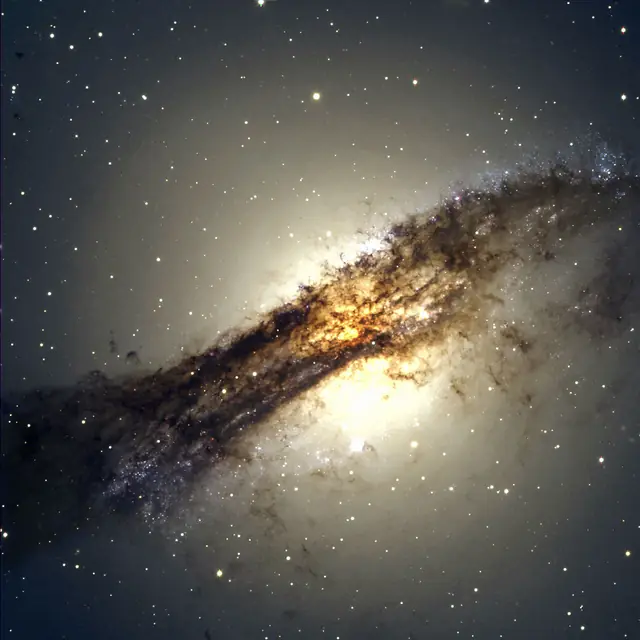
A peculiar galaxy, one of the closest radio galaxies to Earth. Visible with binoculars, its distinctive dust lane is best seen in a telescope.
Galaxy in Centaurus. Magnitude 6.8.
Can you see it from Guyana?
From Georgetown (6.8° N) it climbs to 40° above the southern horizon at its highest; from Lethem (3.4° N), to 43° above the southern horizon. It is highest at midnight on the night of 10 Apr, in the middle of its season. The page works out tonight's rise, highest point and set for both towns in Guyana time (UTC-4), and where the Moon is.
What you'll see
- Your eyes: Not visible to the eye.
- 10x50 binoculars: A faint smudge from a dark site.
- A small telescope (80 to 100 mm): A round glow crossed by a dark dust lane under dark skies.
- A camera: Spans about 40% of an APS-C frame at 1,500 mm (field 0.9° × 0.6°); needs a tracking mount.
How big, how bright, how far
- Size on the sky: 26′ × 20′, 84% of the Moon's width (the Moon is about 31′ wide).
- Brightness: magnitude 6.8. Fainter than the faintest stars in Georgetown (4.3) and Lethem (6.0): binoculars or a telescope.
- Distance: 12 million light-years. The light reaching your eye left it about 12 million years ago.
- True size: 93,000 light-years across its catalogued outline; light crosses it in 93,000 years.
Apparent size from OpenNGC (Mattia Verga), CC-BY-SA-4.0.
What it is made of
- Type
- Peculiar Galaxy / Radio Galaxy
What is in it, not measured:
- Elliptical Galaxy Component: Older stellar population
- Dust Lane: Result of a past merger, site of star formation
- Active Galactic Nucleus (AGN): Supermassive black hole powering radio jets
- Radio Lobes: Extend far beyond the visible galaxy
How we know: Distance from its brightest red giants (the tip of the red giant branch): NED-D median of 17 TRGB estimates, 3.78 Mpc, retrieved 2026-10-21. True size: the apparent size times the distance (apparent size: OpenNGC (Verga, CC-BY-SA-4.0) commit 75ca7ff; HyperLEDA (NGC5128)).
More deep-sky objects: Southern Pinwheel Galaxy (M83) · Antennae Galaxies (NGC 4038 and NGC 4039) · Sombrero Galaxy (M104) · NGC 2997 (Galaxy) · M61 (Galaxy) · M49 (Galaxy)