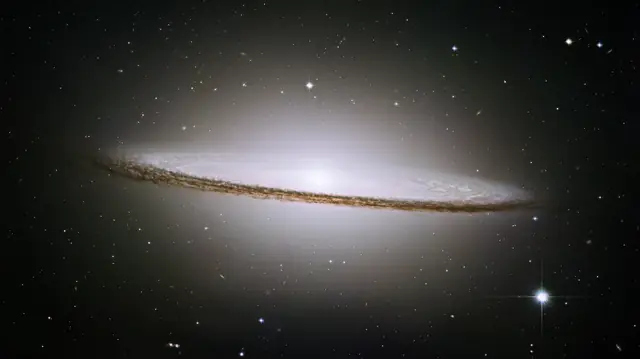
Sombrero Galaxy (M104)
An edge-on spiral galaxy with a prominent dark dust lane, giving it the appearance of a sombrero; requires a telescope for this feature.
Galaxy in Virgo. Magnitude 8.0.
Can you see it from Guyana?
From Georgetown (6.8° N) it climbs to 71° above the southern horizon at its highest; from Lethem (3.4° N), to 75° above the southern horizon. It is highest at midnight on the night of 30 Mar, in the middle of its season. The page works out tonight's rise, highest point and set for both towns in Guyana time (UTC-4), and where the Moon is.
What you'll see
- Your eyes: Not visible to the eye.
- 10x50 binoculars: An oval glow with a brighter core.
- A small telescope (80 to 100 mm): An elongated glow with a bright core; the dark dust lane needs a dark sky and higher power.
- A camera: Tiny on camera: it needs 2,000 mm or more of focal length on a tracking mount.
How big, how bright, how far
- Size on the sky: 9′ × 4′, 29% of the Moon's width (the Moon is about 31′ wide).
- Brightness: magnitude 8.0. Fainter than the faintest stars in Georgetown (4.3) and Lethem (6.0): binoculars or a telescope.
- Distance: 29 million light-years. The light reaching your eye left it about 29 million years ago.
What it is made of
- Type
- Galaxy
- Distance
- Approx. 29 million Lightyears
- True size
- Approx. 50,000 Lightyears diameter
- Bulge Stars: Massive bright core region
- Dust Lane: Prominent edge-on structure silhouette
- Halo & Dark Matter: Extensive elliptical halo, gravitationally inferred DM

More deep-sky objects: Southern Pinwheel Galaxy (M83) · Centaurus A (NGC 5128) · Black Eye Galaxy (M64) · Needle Galaxy (NGC 4565) · Galaxy M106 · Whirlpool Galaxy (M51)