Small Sagittarius Star Cloud (M24)
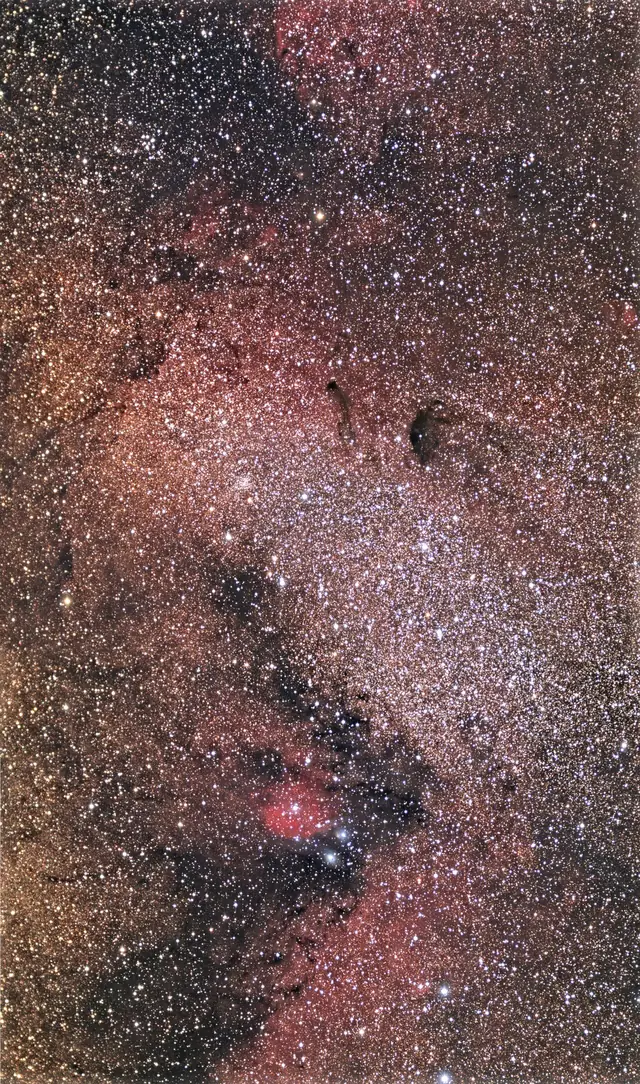
Not a cluster but a window: a gap in the Milky Way's dust in Sagittarius through which we see a dense cloud of distant stars. Its stars are many thousands of light-years away, at many different distances.
Star cloud in Sagittarius. Magnitude 4.5.
Can you see it from Guyana?
From Georgetown (6.8° N) it climbs to 65° above the southern horizon at its highest; from Lethem (3.4° N), to 68° above the southern horizon. It is highest at midnight on the night of 23 Jun, in the middle of its season. The page works out tonight's rise, highest point and set for both towns in Guyana time (UTC-4), and where the Moon is.
What you'll see
- Your eyes: Visible to the eye only from a dark site, as a bright patch of Milky Way; lost in city skies. It lies 7.4° north of Kaus Borealis.
- 10x50 binoculars: A misty patch around its stars.
- A small telescope (80 to 100 mm): Too big for a telescope field: sweep it at the lowest power for a carpet of faint stars, dark lanes and small clusters.
- A camera: Spans about 40% of an APS-C frame at 300 mm (field 4.5° × 3.0°); needs a tracking mount.
How big, how bright, how far
- Size on the sky: 120′ × 60′, 3.9 Moons across (the Moon is about 31′ wide).
- Brightness: magnitude 4.5. Fainter than Georgetown's faintest stars (4.3) but brighter than Lethem's (6.0).
Apparent size from OpenNGC (Mattia Verga), CC-BY-SA-4.0.
What it is made of
- Type
- Star cloud in the Milky Way
- Notable
- A break in the dust lets us see stars deeper toward an inner spiral arm of the galaxy, many thousands of light-years away.
What is in it, not measured:
- Countless stars: at many distances, seen through a gap in the foreground dust
How we know: True size: No single size: its stars lie at many distances, IC 4715 is a star cloud, a window through the dust onto stars at many distances; SIMBAD lists no distance for it, so no true size is derived.
More deep-sky objects: M18 (Open Cluster) · Omega Nebula (M17) · M25 (Open Cluster IC 4725) · M23 (Open Cluster) · Eagle Nebula (M16) · M21 (Open Cluster)