Omega Nebula (M17)
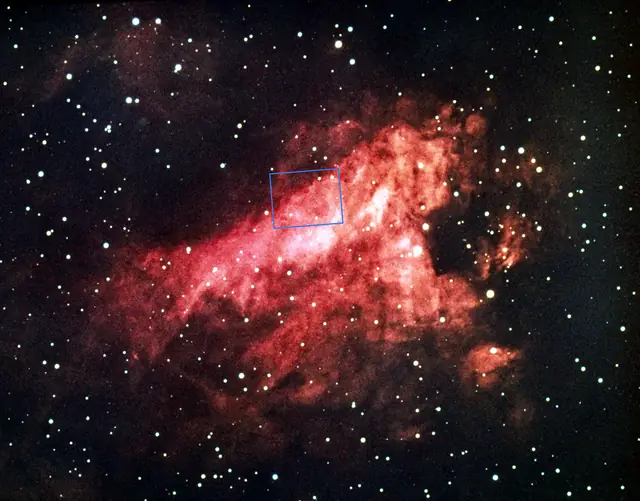
Also known as the Swan Nebula or Checkmark Nebula, a bright star-forming region visible with binoculars.
Nebula in Sagittarius. Magnitude 6.0.
Can you see it from Guyana?
From Georgetown (6.8° N) it climbs to 67° above the southern horizon at its highest; from Lethem (3.4° N), to 70° above the southern horizon. It is highest at midnight on the night of 24 Jun, in the middle of its season. The page works out tonight's rise, highest point and set for both towns in Guyana time (UTC-4), and where the Moon is.
What you'll see
- Your eyes: Visible to the eye only from a dark site, as a misty patch; lost in city skies.
- 10x50 binoculars: A misty patch around its stars.
- A small telescope (80 to 100 mm): Shows its brighter structure; a nebula (UHC or OIII) filter helps.
- A camera: Spans about 40% of an APS-C frame at 800 mm (field 1.7° × 1.1°); needs a tracking mount. An H-alpha-sensitive (modified) camera brings out its red glow.
How big, how bright, how far
- Size on the sky: 46′ × 37′, 1.5 Moons across (the Moon is about 31′ wide).
- Brightness: magnitude 6.0. Fainter than Georgetown's faintest stars (4.3) but brighter than Lethem's (6.0).
- Distance: 5,000 light-years. The light reaching your eye left it about 5,000 years ago.
- True size: 66 light-years across its catalogued outline; light crosses it in 66 years.
What it is made of
- Type
- Emission Nebula
What is in it, not measured:
- Ionized Hydrogen (HII): Dominant emission, pink-red color
- Dust Lanes: Obscures parts of nebula
- Young Star Cluster: Embedded, excites nebula
How we know: Distance from Gaia distances to stars in front of and behind its dust: Zucker et al. 2020, A&A 633, A51 (Gaia DR2 cloud distances, VizieR J/A+A/633/A51): median of the three M17 sightlines, 1509 pc (16th-84th percentiles 1474-1591 pc). True size: the apparent size times the distance (apparent size: HEASARC messier table (Sky Catalogue 2000.0, Hirshfeld & Sinnott 1985), via HEASARC TAP 2026-10-02 (M17)).
More deep-sky objects: Trifid Nebula (M20) · Lagoon Nebula (M8) · R Coronae Australis Nebula (NGC 6729) · Rho Ophiuchi Nebula (IC 4604) · IC 4628 (Nebula) · North America Nebula (NGC 7000)