North America Nebula (NGC 7000)
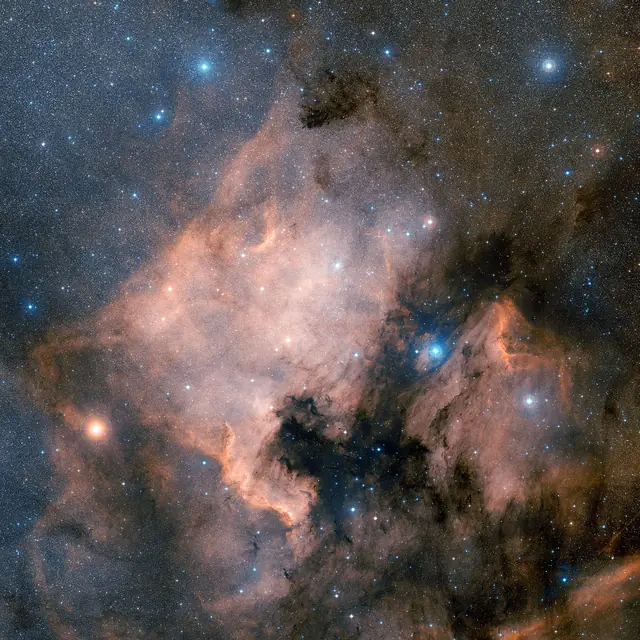
An emission nebula in Cygnus, named for its resemblance to the continent. Visible with binoculars under very dark skies; its shape is best seen in photographs or with wide-field telescopes.
Nebula in Cygnus. Magnitude 4.0.
Can you see it from Guyana?
From Georgetown (6.8° N) it climbs to 52° above the northern horizon at its highest; from Lethem (3.4° N), to 49° above the northern horizon. It is highest at midnight on the night of 3 Aug, in the middle of its season. The page works out tonight's rise, highest point and set for both towns in Guyana time (UTC-4), and where the Moon is.
What you'll see
- Your eyes: From a dark site, a faint brighter patch of Milky Way beside Deneb; invisible from towns.
- 10x50 binoculars: Its shape shows best with a UHC or OIII filter, from a dark site.
- A small telescope (80 to 100 mm): Too big for most telescope fields; use the lowest power and a nebula filter.
- A camera: Spans about 40% of an APS-C frame at 300 mm (field 4.5° × 3.0°); needs a tracking mount. An H-alpha-sensitive (modified) camera brings out its red glow.
How big, how bright, how far
- Size on the sky: 120′, 3.9 Moons across (the Moon is about 31′ wide).
- Brightness: magnitude 4.0. Brighter than the faintest stars Georgetown shows (4.3), and Lethem's (6.0).
- Distance: 2,590 light-years. The light reaching your eye left it about 2,600 years ago.
What it is made of
- Type
- Emission Nebula (HII Region)
- Distance
- Approx. 2,590 Lightyears
- True size
- Approx. 100 Lightyears across (4x Moon diameter)
- Ionized Hydrogen (HII): Forms the characteristic shape, emits red light
- Dark Dust Lanes (Cygnus Wall): Obscuring dust forming the 'Gulf of Mexico'
- Young Stars: Embedded within the nebula
More deep-sky objects: Omega Nebula (M17) · California Nebula (NGC 1499) · Trifid Nebula (M20) · Lagoon Nebula (M8) · Rosette Nebula (Caldwell 49) · Orion Nebula (M42)