Rosette Nebula (Caldwell 49)
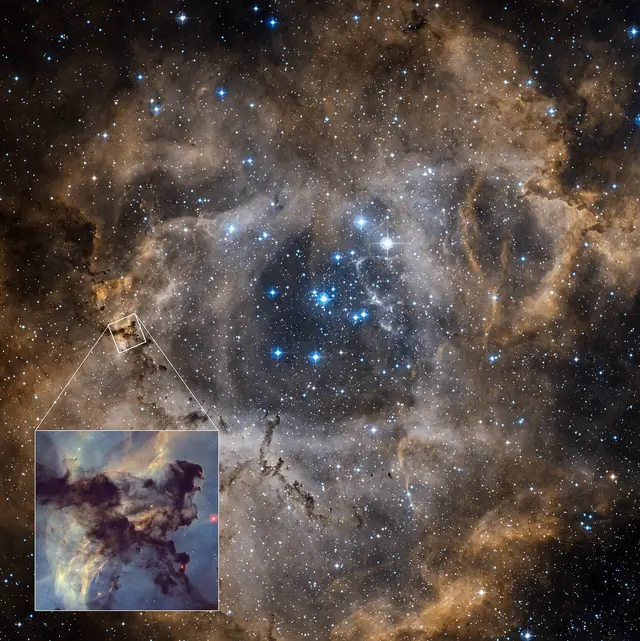
A large, circular H II region located near one end of a giant molecular cloud in Monoceros. The associated star cluster NGC 2244 (mag 4.8) is visible in binoculars, but the nebula itself requires a telescope or long-exposure photography.
Nebula in Monoceros. Magnitude 9.0.
Can you see it from Guyana?
From Georgetown (6.8° N) it climbs to 88°, almost straight overhead at its highest; from Lethem (3.4° N), to 88°, almost straight overhead. It is highest at midnight on the night of 27 Dec, in the middle of its season. The page works out tonight's rise, highest point and set for both towns in Guyana time (UTC-4), and where the Moon is.
What you'll see
- Your eyes: Not visible to the eye; the cluster NGC 2244 inside it is.
- 10x50 binoculars: The cluster NGC 2244 shows; the nebula needs a filter and a dark site.
- A small telescope (80 to 100 mm): Low power and a UHC or OIII filter show the ring around the cluster.
- A camera: Spans about 40% of an APS-C frame at 400 mm (field 3.4° × 2.2°); needs a tracking mount. An H-alpha-sensitive (modified) camera brings out its red glow.
How big, how bright, how far
- Size on the sky: 80′ × 50′, 2.6 Moons across (the Moon is about 31′ wide).
- Brightness: magnitude 9.0. Fainter than the faintest stars in Georgetown (4.3) and Lethem (6.0): binoculars or a telescope.
- Distance: 5,200 light-years. The light reaching your eye left it about 5,200 years ago.
Apparent size from OpenNGC (Mattia Verga), CC-BY-SA-4.0.
What it is made of
- Type
- Emission Nebula with Open Cluster
- Distance
- Approx. 5,200 Lightyears
- True size
- Approx. 130 Lightyears diameter
- Ionized Hydrogen (HII): Forms the rose-like structure
- NGC 2244 Open Cluster: Young, hot stars in the center, clearing out a cavity
- Dust and Molecular Gas: Outer regions, fuel for ongoing star formation
More deep-sky objects: Orion Nebula (M42) · California Nebula (NGC 1499) · Tarantula Nebula (NGC 2070) · Eta Carinae Nebula (NGC 3372) · North America Nebula (NGC 7000) · Lagoon Nebula (M8)