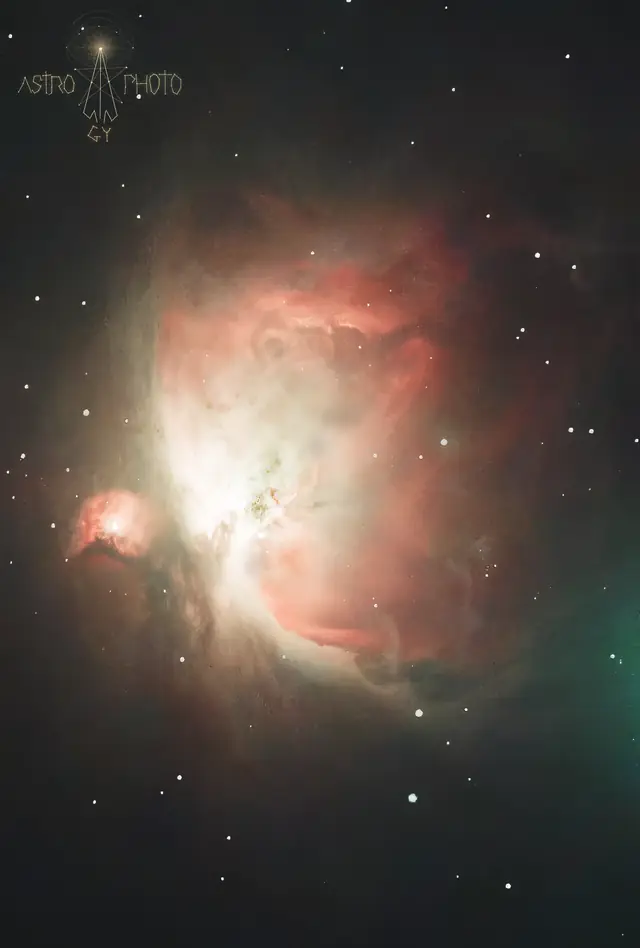
Orion Nebula (M42)
A stellar nursery, the closest region of massive star formation to Earth, visible to the naked eye.
Nebula in Orion. Magnitude 4.0.
Can you see it from Guyana?
From Georgetown (6.8° N) it climbs to 78° above the southern horizon at its highest; from Lethem (3.4° N), to 81° above the southern horizon. It is highest at midnight on the night of 12 Dec, in the middle of its season. The page works out tonight's rise, highest point and set for both towns in Guyana time (UTC-4), and where the Moon is.
What you'll see
- Your eyes: Visible to the eye even from Georgetown, as a misty patch.
- 10x50 binoculars: A misty patch with the Trapezium stars at its heart.
- A small telescope (80 to 100 mm): Wings of nebula around the four Trapezium stars; one of the finest sights in a small telescope.
- A camera: About 400 mm frames it on a tracking mount; add short exposures so the bright core does not burn out.
How big, how bright, how far
- Size on the sky: 65′ × 60′, 2.1 Moons across (the Moon is about 31′ wide).
- Brightness: magnitude 4.0. Brighter than the faintest stars Georgetown shows (4.3), and Lethem's (6.0).
- Distance: 1,300 light-years. The light reaching your eye left it about 1,300 years ago, around the year 730.
- True size: 25 light-years across its catalogued outline; light crosses it in 25 years.
What it is made of
- Type
- Emission Nebula
Measured: What its glowing gas is made of, counted in atoms.
- Hydrogen: 91.1%, glows red
- Helium: 8.9%
- Everything heavier: 0.08%, oxygen, carbon, neon, nitrogen, sulphur and more
About 1 atom in 1,200 is heavier than helium; oxygen alone is 1 in 2,300. Measured from 555 emission lines with the VLT: helium, carbon, nitrogen, oxygen, neon, sulphur, chlorine, argon and iron relative to hydrogen (Esteban et al. 2004, MNRAS 355, 229, Table 14, t² = 0.022). The gas is 8,300 to 10,000 K, from the same spectra.
Measured: What its glowing gas is made of, by weight.
- Hydrogen: 71.4%
- Helium: 27.6%
- Everything heavier: 1%, mostly oxygen and carbon
Iron and silicon locked in its dust are not in this tally. Measured from 555 emission lines with the VLT: helium, carbon, nitrogen, oxygen, neon, sulphur, chlorine, argon and iron relative to hydrogen (Esteban et al. 2004, MNRAS 355, 229, Table 14, t² = 0.022). The gas is 8,300 to 10,000 K, from the same spectra.
Also in it, not measured:
- Dust grains: silicates and carbon grains that form its dark lanes; not in the gas tally
- Young stars: the Trapezium Cluster, whose light makes the gas glow
How we know: Distance from radio parallax of its young stars: Menten et al. 2007, A&A 474, 515 (VLBA parallax, arXiv:0709.0485): 414 +/- 7 pc; Kounkel et al. 2017, ApJ 834, 142 (VLBA parallax, arXiv:1609.04041): 388 +/- 5 pc; the two disagree, so the rounded midpoint. True size: the apparent size times the distance (apparent size: the site catalogue).
More deep-sky objects: Rosette Nebula (Caldwell 49) · Monkey Head Nebula (NGC 2174) · California Nebula (NGC 1499) · Tarantula Nebula (NGC 2070) · Eta Carinae Nebula (NGC 3372) · Iris Nebula (NGC 7023)