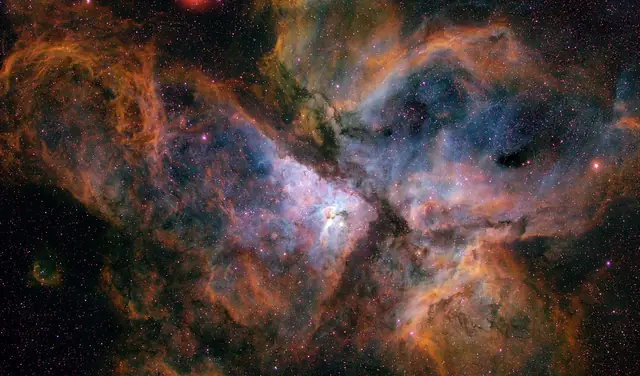
Eta Carinae Nebula (NGC 3372)
A vast star-forming region in the constellation Carina, easily visible to the naked eye and one of the largest diffuse nebulae in our skies.
Nebula in Carina. Magnitude 1.0.
Can you see it from Guyana?
From Georgetown (6.8° N) it climbs to 23° above the southern horizon at its highest; from Lethem (3.4° N), to 27° above the southern horizon. It is highest at midnight on the night of 1 Mar, in the middle of its season. The page works out tonight's rise, highest point and set for both towns in Guyana time (UTC-4), and where the Moon is.
What you'll see
- Your eyes: Visible to the eye from a dark site as a bright knot in the southern Milky Way, low in the south: 23° from Georgetown, 27° from Lethem.
- 10x50 binoculars: A misty patch around its stars.
- A small telescope (80 to 100 mm): Bright nebula split by dark lanes, with the star Eta Carinae inside; a UHC or OIII filter helps.
- A camera: Spans about 40% of an APS-C frame at 300 mm (field 4.5° × 3.0°); needs a tracking mount. An H-alpha-sensitive (modified) camera brings out its red glow.
How big, how bright, how far
- Size on the sky: 120′, 3.9 Moons across (the Moon is about 31′ wide).
- Brightness: magnitude 1.0. Brighter than the faintest stars Georgetown shows (4.3), and Lethem's (6.0).
- Distance: 7,500 light-years. The light reaching your eye left it about 7,500 years ago.
What it is made of
- Type
- Emission Nebula
- Distance
- Approx. 7,500 Lightyears
- True size
- Approx. 460 Lightyears diameter
- Ionized Hydrogen (HII): Extensive bright and dark nebulosity
- Eta Carinae Star System: Highly luminous and unstable massive binary
- Keyhole Nebula: Dark dust cloud silhouetted against bright gas
- Young Star Clusters: Trumpler 14, Trumpler 16, ionize the nebula
More deep-sky objects: Tarantula Nebula (NGC 2070) · Lagoon Nebula (M8) · Orion Nebula (M42) · Trifid Nebula (M20) · Rosette Nebula (Caldwell 49) · Omega Nebula (M17)