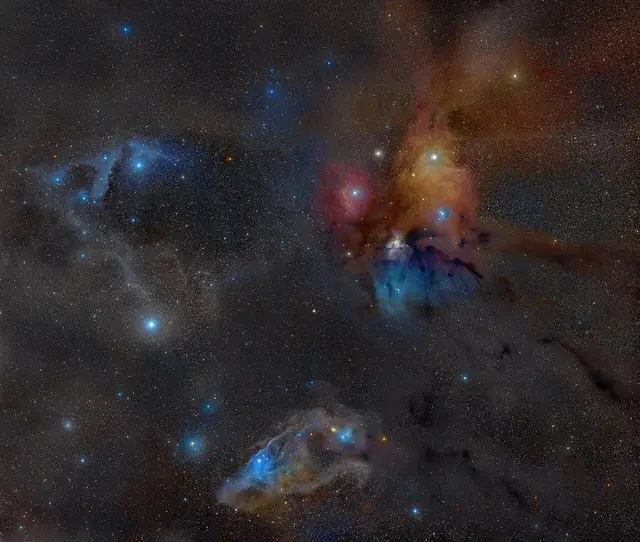
Rho Ophiuchi Nebula (IC 4604)
A cloud of dust in Ophiuchus lit blue by Rho Ophiuchi, the star at its heart, about 450 light-years away. It is the second nearest nebula on this site, 3.1° north of Antares.
Nebula in Ophiuchus.
Can you see it from Guyana?
From Georgetown (6.8° N) it climbs to 60° above the southern horizon at its highest; from Lethem (3.4° N), to 63° above the southern horizon. It is highest at midnight on the night of 26 May, in the middle of its season. The page works out tonight's rise, highest point and set for both towns in Guyana time (UTC-4), and where the Moon is.
What you'll see
- Your eyes: Not visible to the eye; the star Rho Ophiuchi at its heart is.
- 10x50 binoculars: A faint haze around the star Rho Ophiuchi, from a dark site.
- A small telescope (80 to 100 mm): Too big for a telescope field; it shows best in photographs.
- A camera: Spans about 40% of an APS-C frame at 500 mm (field 2.7° × 1.8°); needs a tracking mount.
How big, how bright, how far
- Size on the sky: 60′ × 25′, 1.9 Moons across (the Moon is about 31′ wide).
- Distance: 450 light-years. The light reaching your eye left it about 450 years ago, around the year 1580.
- True size: 7.8 light-years across its catalogued outline; light crosses it in 7.8 years.
Apparent size from OpenNGC (Mattia Verga), CC-BY-SA-4.0.
What it is made of
- Type
- Reflection nebula
What is in it, not measured:
- Dust: scattering a nearby star's light, which is why it looks blue
- Cold gas: that the dust lives in
- A young star: that lights it
How we know: Distance from the Gaia parallax of Rho Ophiuchi A, the star at its heart, and Gaia distances to the dust cloud around it: Gaia EDR3 parallax via SIMBAD (basic.plx_value, 2020yCat.1350....0G), distance = 1/parallax, retrieved 2026-10-21 (HD 147933, rho Oph A: 7.261 +/- 0.1318 mas, 137.7 pc); Zucker et al. 2020, A&A 633, A51 (2020A&A...633A..51Z, via SIMBAD mesDistance): the rho Oph cloud at 128 and 139 pc. Hipparcos gives the pair 9.03 +/- 0.90 mas (about 111 pc; van Leeuwen 2007), and Gaia EDR3 puts its companion rho Oph B at 5.48 mas, so the star alone does not settle it. True size: the apparent size times the distance (apparent size: OpenNGC (Mattia Verga, CC BY-SA 4.0), commit 4e2398a2).

More deep-sky objects: IC 4628 (Nebula) · Trifid Nebula (M20) · Lagoon Nebula (M8) · Omega Nebula (M17) · R Coronae Australis Nebula (NGC 6729) · Eta Carinae Nebula (NGC 3372)