M34 (Open Cluster)
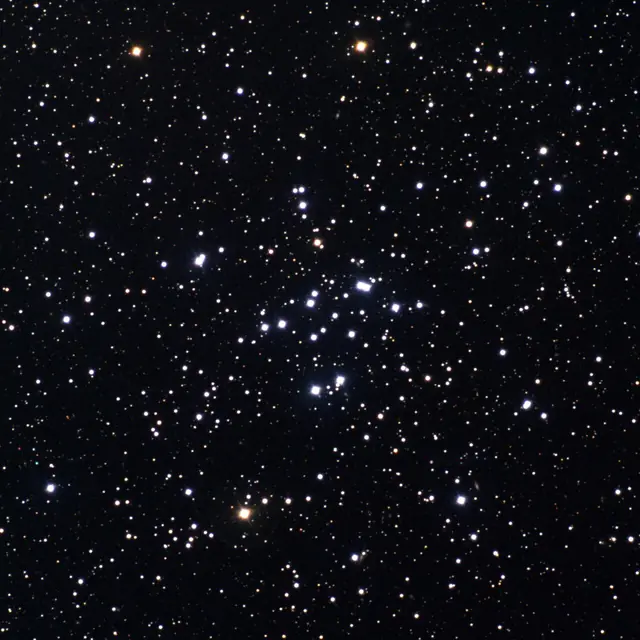
A bright, scattered open cluster in Perseus, about 1,600 light-years away and 120 million years old. It spans 22 arcminutes, so it suits binoculars and low power.
Open cluster in Perseus. Magnitude 5.2.
Can you see it from Guyana?
From Georgetown (6.8° N) it climbs to 54° above the northern horizon at its highest; from Lethem (3.4° N), to 51° above the northern horizon. It is highest at midnight on the night of 29 Oct, in the middle of its season. The page works out tonight's rise, highest point and set for both towns in Guyana time (UTC-4), and where the Moon is.
What you'll see
- Your eyes: Visible to the eye only from a dark site, as a hazy knot of stars; lost in city skies. It lies 5.2° west of Algol.
- 10x50 binoculars: Resolves into dozens of stars.
- A small telescope (80 to 100 mm): Too loose for high power: at low power, several dozen stars spread over the field.
- A camera: Spans about 40% of an APS-C frame at 1,500 mm (field 0.9° × 0.6°); needs a tracking mount.
How big, how bright, how far
- Size on the sky: 22.5′, 72% of the Moon's width (the Moon is about 31′ wide).
- Brightness: magnitude 5.2. Fainter than Georgetown's faintest stars (4.3) but brighter than Lethem's (6.0).
- Distance: 1,600 light-years. The light reaching your eye left it about 1,600 years ago, around the year 430.
- True size: 10 light-years across its catalogued outline; light crosses it in 10 years.
Apparent size from OpenNGC (Mattia Verga), CC-BY-SA-4.0.
What it is made of
- Type
- Open cluster
- Mass
- About 1,400 times the Sun's mass, in its stars
- Age
- About 120 million years (range 72 million years to 230 million years)
What is in it, not measured:
- Stars born together: from one cloud of gas, at one time
How we know: Distance from Gaia parallaxes of its stars: Hunt & Reffert 2024, A&A 686, A42 (Gaia DR3 cluster catalogue, VizieR J/A+A/686/A42), retrieved 2026-10-21: NGC 1039 490 pc; statistical 1,596-1,598 ly (16th-84th percentile); Gaia DR3 parallax zero-point systematics (about 0.02 mas) add under 1%. True size: the apparent size times the distance (apparent size: OpenNGC (Mattia Verga, CC BY-SA 4.0), commit 4e2398a2). Mass: Hunt & Reffert 2024, A&A 686, A42 (Gaia DR3 cluster catalogue, VizieR J/A+A/686/A42), retrieved 2026-10-21, NGC 1039: total 1,390 ± 105 Suns.
More deep-sky objects: NGC 752 (Open Cluster) · Alpha Persei Cluster (Melotte 20) · Double Cluster (NGC 869 & NGC 884) · Soul Nebula (IC 1848) · Heart Nebula (IC 1805) · NGC 457 (ET Cluster / Owl Cluster)