M48 (Open Cluster)
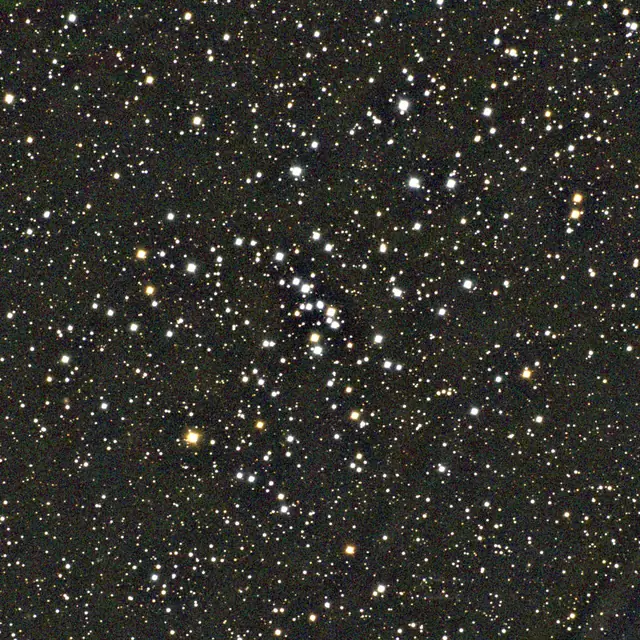
A large open cluster in Hydra, about 380 million years old. Messier's published position was wrong, so it was a "missing" Messier object until the 1950s.
Open cluster in Hydra. Magnitude 5.8.
Can you see it from Guyana?
From Georgetown (6.8° N) it climbs to 77° above the southern horizon at its highest; from Lethem (3.4° N), to 81° above the southern horizon. It is highest at midnight on the night of 21 Jan, in the middle of its season. The page works out tonight's rise, highest point and set for both towns in Guyana time (UTC-4), and where the Moon is.
What you'll see
- Your eyes: Visible to the eye only from a dark site, as a hazy knot of stars; lost in city skies. It lies 13.9° south-east of Procyon.
- 10x50 binoculars: Resolves into dozens of stars.
- A small telescope (80 to 100 mm): Too big for high power: at low power, many stars spread over half a degree.
- A camera: Spans about 40% of an APS-C frame at 1,000 mm (field 1.3° × 0.9°); needs a tracking mount.
How big, how bright, how far
- Size on the sky: 28.2′, 91% of the Moon's width (the Moon is about 31′ wide).
- Brightness: magnitude 5.8. Fainter than Georgetown's faintest stars (4.3) but brighter than Lethem's (6.0).
- Distance: 2,440 light-years. The light reaching your eye left it about 2,440 years ago.
- True size: 20 light-years across its catalogued outline; light crosses it in 20 years.
Apparent size from OpenNGC (Mattia Verga), CC-BY-SA-4.0.
What it is made of
- Type
- Open cluster
- Mass
- About 1,530 times the Sun's mass, in its stars
- Age
- About 380 million years (range 240 million years to 670 million years)
- Notable
- Unidentified until the 1950s because of a five-degree error in Messier's published position.
What is in it, not measured:
- Stars born together: from one cloud of gas, at one time
- Red giants: stars that have already aged and swollen
How we know: Distance from Gaia parallaxes of its stars: Hunt & Reffert 2024, A&A 686, A42 (Gaia DR3 cluster catalogue, VizieR J/A+A/686/A42), retrieved 2026-10-21: NGC 2548 747 pc; statistical 2,434-2,439 ly (16th-84th percentile); Gaia DR3 parallax zero-point systematics (about 0.02 mas) add about 1%. True size: the apparent size times the distance (apparent size: OpenNGC (Mattia Verga, CC BY-SA 4.0), commit 4e2398a2). Mass: Hunt & Reffert 2024, A&A 686, A42 (Gaia DR3 cluster catalogue, VizieR J/A+A/686/A42), retrieved 2026-10-21, NGC 2548: total 1,531 ± 86 Suns.
More deep-sky objects: M46 (Open Cluster) & NGC 2438 (Planetary Nebula) · M47 (Open Cluster) · Caroline's Cluster (NGC 2360) · M50 (Open Cluster) · M93 (Open Cluster) · M67 (Open Cluster)