M50 (Open Cluster)
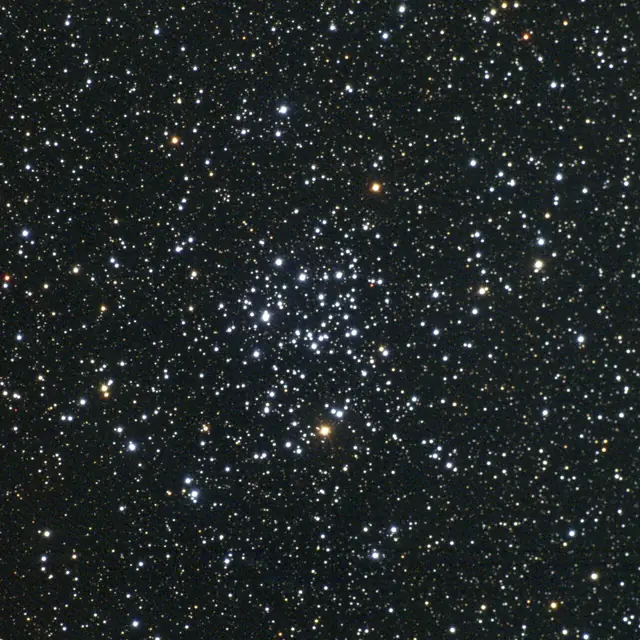
An open cluster in Monoceros, about 3,100 light-years away and 140 million years old. Its brighter stars make a shape some see as a heart.
Open cluster in Monoceros. Magnitude 5.9.
Can you see it from Guyana?
From Georgetown (6.8° N) it climbs to 75° above the southern horizon at its highest; from Lethem (3.4° N), to 78° above the southern horizon. It is highest at midnight on the night of 3 Jan, in the middle of its season. The page works out tonight's rise, highest point and set for both towns in Guyana time (UTC-4), and where the Moon is.
What you'll see
- Your eyes: Visible to the eye only from a dark site, as a hazy knot of stars; lost in city skies. It lies 9.4° north-east of Sirius.
- 10x50 binoculars: Resolves into dozens of stars.
- A small telescope (80 to 100 mm): A rich group of stars at low power, with a few brighter ones among them.
- A camera: Spans about 40% of an APS-C frame at 2,000 mm (field 0.7° × 0.4°); needs a tracking mount.
How big, how bright, how far
- Size on the sky: 14.1′, 45% of the Moon's width (the Moon is about 31′ wide).
- Brightness: magnitude 5.9. Fainter than Georgetown's faintest stars (4.3) but brighter than Lethem's (6.0).
- Distance: 3,120 light-years. The light reaching your eye left it about 3,120 years ago.
- True size: 13 light-years across its catalogued outline; light crosses it in 13 years.
Apparent size from OpenNGC (Mattia Verga), CC-BY-SA-4.0.
What it is made of
- Type
- Open cluster
- Mass
- About 1,800 times the Sun's mass, in its stars
- Age
- About 140 million years (range 88 million years to 240 million years)
What is in it, not measured:
- Stars born together: from one cloud of gas, at one time
How we know: Distance from Gaia parallaxes of its stars: Hunt & Reffert 2024, A&A 686, A42 (Gaia DR3 cluster catalogue, VizieR J/A+A/686/A42), retrieved 2026-10-21: NGC 2323 957 pc; statistical 3,117-3,123 ly (16th-84th percentile); Gaia DR3 parallax zero-point systematics (about 0.02 mas) add about 2%. True size: the apparent size times the distance (apparent size: OpenNGC (Mattia Verga, CC BY-SA 4.0), commit 4e2398a2). Mass: Hunt & Reffert 2024, A&A 686, A42 (Gaia DR3 cluster catalogue, VizieR J/A+A/686/A42), retrieved 2026-10-21, NGC 2323: total 1,789 ± 201 Suns.
More deep-sky objects: Caroline's Cluster (NGC 2360) · M47 (Open Cluster) · M46 (Open Cluster) & NGC 2438 (Planetary Nebula) · M41 (Open Cluster) · NGC 2362 (Open Cluster) · M48 (Open Cluster)