M75 (Globular Cluster)
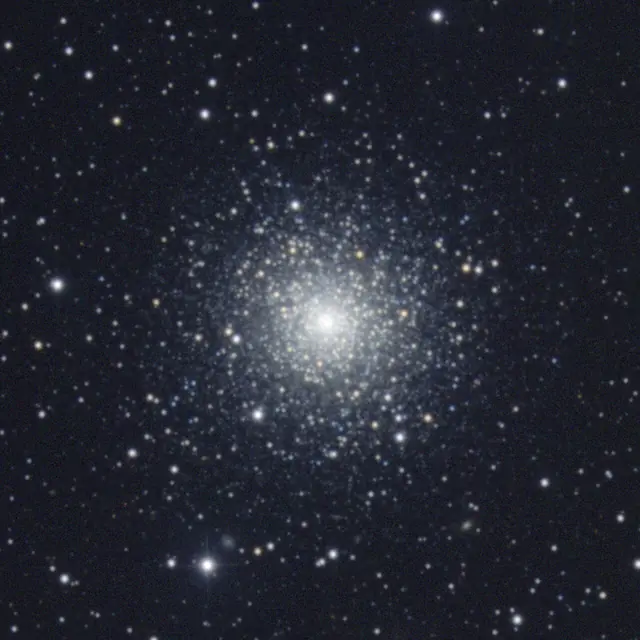
One of the most remote Messier globulars, about 67,000 light-years away in Sagittarius. It is massive and concentrated, so it looks small and bright.
Globular cluster in Sagittarius. Magnitude 8.5.
Can you see it from Guyana?
From Georgetown (6.8° N) it climbs to 61° above the southern horizon at its highest; from Lethem (3.4° N), to 65° above the southern horizon. It is highest at midnight on the night of 21 Jul, in the middle of its season. The page works out tonight's rise, highest point and set for both towns in Guyana time (UTC-4), and where the Moon is.
What you'll see
- Your eyes: Not visible to the eye. It lies 13.1° east of Albaldah.
- 10x50 binoculars: A round glow, brighter towards the middle.
- A small telescope (80 to 100 mm): A small, bright, concentrated glow; it needs a large telescope to resolve.
- A camera: Tiny on camera: it needs 2,000 mm or more of focal length on a tracking mount.
How big, how bright, how far
- Size on the sky: 3.6′, 12% of the Moon's width (the Moon is about 31′ wide).
- Brightness: magnitude 8.5. Fainter than the faintest stars in Georgetown (4.3) and Lethem (6.0): binoculars or a telescope.
- Distance: 67,000 light-years. The light reaching your eye left it about 67,000 years ago.
- True size: 70 light-years across its catalogued outline; light crosses it in 70 years.
Apparent size from OpenNGC (Mattia Verga), CC-BY-SA-4.0.
What it is made of
- Type
- Globular cluster
- Mass
- About 460,000 times the Sun's mass
- Notable
- Massive: about 459,000 Suns, 22nd of the 167 globulars in the Baumgardt database.
What is in it, not measured:
- Old stars: among the oldest in the Milky Way
- Stellar remnants: white dwarfs and neutron stars
- Almost no gas or dust
How we know: Distance from Gaia, Hubble and earlier distances to its stars, combined: Baumgardt & Vasiliev 2021, MNRAS 505, 5957; Baumgardt globular cluster database, combined_table.txt, retrieved 2026-10-21 (NGC 6864: 20.52 +/- 0.45 kpc). True size: the apparent size times the distance (apparent size: OpenNGC (Mattia Verga, CC BY-SA 4.0), commit 4e2398a2). Mass: Baumgardt globular cluster database, combined_table.txt (NGC 6864: 459,000 ± 58,400 Suns), retrieved 2026-10-21; Baumgardt & Vasiliev 2021, MNRAS 505, 5957.
More deep-sky objects: M55 (Globular Cluster) · M72 (Globular Cluster) · M54 (Globular Cluster) · Globular Cluster M22 · M70 (Globular Cluster) · M30 (Globular Cluster)