M79 (Globular Cluster)
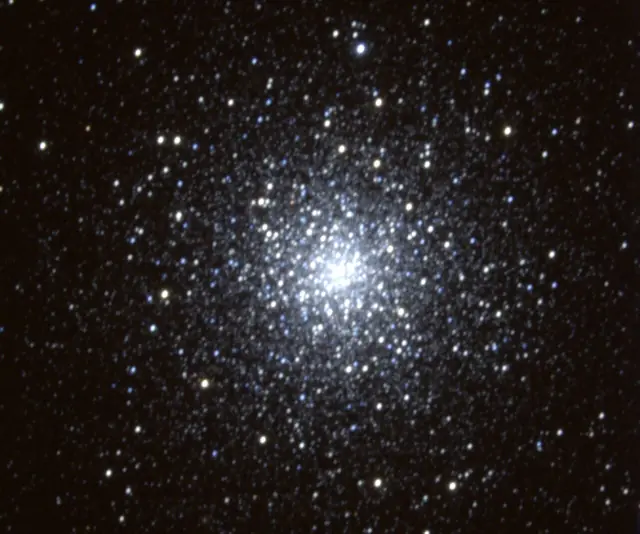
A globular cluster in Lepus, south of Orion, about 43,000 light-years away. It lies farther from the centre of the galaxy than the Sun does.
Globular cluster in Lepus. Magnitude 7.9.
Can you see it from Guyana?
From Georgetown (6.8° N) it climbs to 59° above the southern horizon at its highest; from Lethem (3.4° N), to 62° above the southern horizon. It is highest at midnight on the night of 9 Dec, in the middle of its season. The page works out tonight's rise, highest point and set for both towns in Guyana time (UTC-4), and where the Moon is.
What you'll see
- Your eyes: Not visible to the eye. It lies 3.9° south of Nihal.
- 10x50 binoculars: A round glow, brighter towards the middle.
- A small telescope (80 to 100 mm): A small, round, bright glow; at higher power its edge turns grainy.
- A camera: Tiny on camera: it needs 2,000 mm or more of focal length on a tracking mount.
How big, how bright, how far
- Size on the sky: 7.2′, 23% of the Moon's width (the Moon is about 31′ wide).
- Brightness: magnitude 7.9. Fainter than the faintest stars in Georgetown (4.3) and Lethem (6.0): binoculars or a telescope.
- Distance: 42,700 light-years. The light reaching your eye left it about 42,700 years ago.
- True size: 89 light-years across its catalogued outline; light crosses it in 89 years.
Apparent size from OpenNGC (Mattia Verga), CC-BY-SA-4.0.
What it is made of
- Type
- Globular cluster
- Mass
- About 181,000 times the Sun's mass
- Notable
- One of the few globulars farther out in the galaxy than the Sun.
What is in it, not measured:
- Old stars: among the oldest in the Milky Way
- Stellar remnants: white dwarfs and neutron stars
- Almost no gas or dust
How we know: Distance from Gaia, Hubble and earlier distances to its stars, combined: Baumgardt & Vasiliev 2021, MNRAS 505, 5957; Baumgardt globular cluster database, combined_table.txt, retrieved 2026-10-21 (NGC 1904: 13.08 +/- 0.18 kpc). True size: the apparent size times the distance (apparent size: OpenNGC (Mattia Verga, CC BY-SA 4.0), commit 4e2398a2). Mass: Baumgardt globular cluster database, combined_table.txt (NGC 1904: 181,000 ± 6,880 Suns), retrieved 2026-10-21; Baumgardt & Vasiliev 2021, MNRAS 505, 5957.
More deep-sky objects: NGC 1851 (Globular Cluster) · M41 (Open Cluster) · NGC 2362 (Open Cluster) · Caroline's Cluster (NGC 2360) · M50 (Open Cluster) · M93 (Open Cluster)