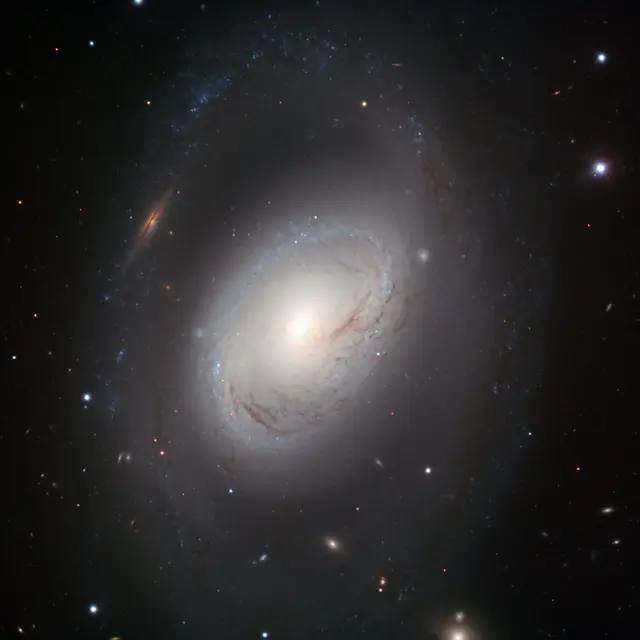
M96 (Galaxy)
The largest galaxy of the Leo I group, 0.7° from M95. Its distance comes from Cepheids and its brightest red giants: about 36 million light-years.
Galaxy in Leo. Magnitude 9.2.
Can you see it from Guyana?
From Georgetown (6.8° N) it climbs to 85° above the northern horizon at its highest; from Lethem (3.4° N), to 82° above the northern horizon. It is highest at midnight on the night of 1 Mar, in the middle of its season. The page works out tonight's rise, highest point and set for both towns in Guyana time (UTC-4), and where the Moon is.
What you'll see
- Your eyes: Not visible to the eye. It lies 9.4° east of Regulus.
- 10x50 binoculars: Just detectable in binoculars from a dark site, as a faint smudge. M95 and M105 are within 1°.
- A small telescope (80 to 100 mm): A bright oval core in a fainter halo; M95 is 0.7° to the west and M105 0.8° to the north.
- A camera: Tiny on camera: it needs 2,000 mm or more of focal length on a tracking mount. At 600 mm, M95, M96 and M105 fit in one frame.
How big, how bright, how far
- Size on the sky: 8.3′ × 5.5′, 27% of the Moon's width (the Moon is about 31′ wide).
- Brightness: magnitude 9.2. Fainter than the faintest stars in Georgetown (4.3) and Lethem (6.0): binoculars or a telescope.
- Distance: 36 million light-years. The light reaching your eye left it about 36 million years ago.
- True size: 85,000 light-years across its catalogued outline; light crosses it in 85,000 years.
Apparent size from OpenNGC (Mattia Verga), CC-BY-SA-4.0.
What it is made of
- Type
- Spiral galaxy
- Notable
- The largest and brightest galaxy of the Leo I group; its core sits off-centre and its arms are uneven, perhaps from the pull of its neighbours.
What is in it, not measured:
- Stars: an older central bulge and a disc of younger stars
- Gas and dust: in the spiral arms, where new stars form
- Dark matter: inferred from how fast it spins
How we know: Distance from Cepheid variable stars and its brightest red giants (the tip of the red giant branch): NED-D (NASA/IPAC Extragalactic Database, redshift-independent distances), median of 31 Cepheids/TRGB estimates: 10.90 Mpc, 10.13-11.70 Mpc (16th-84th percentile); e.g. 2018ApJS..235...23S, 2017ApJ...836...74J, 2013ApJ...773...13L; retrieved 2026-10-21. True size: the apparent size times the distance (apparent size: OpenNGC (Mattia Verga, CC BY-SA 4.0), commit 4e2398a2).
More deep-sky objects: M95 (Galaxy) · M105 (Galaxy) · M98 (Galaxy) · Coma Pinwheel (M99) · M100 (Galaxy) · M84 (Galaxy)