Milky Way Core
The central region of our Milky Way galaxy, a bright, dense area visible to the naked eye in dark skies, especially in summer.
Centre of our galaxy in Sagittarius.
Can you see it from Guyana?
From Georgetown (6.8° N) it climbs to 54° above the southern horizon at its highest; from Lethem (3.4° N), to 58° above the southern horizon. It is highest at midnight on the night of 16 Jun, in the middle of its season. The page works out tonight's rise, highest point and set for both towns in Guyana time (UTC-4), and where the Moon is.
What you'll see
- Your eyes: From a dark site the Milky Way is brightest and widest here, in Sagittarius and Scorpius, with dark dust lanes across it; invisible from Georgetown.
- 10x50 binoculars: Sweep it: star clouds, clusters and nebulae everywhere.
- A small telescope (80 to 100 mm): Too big for a telescope; use it to sweep the clusters and nebulae inside.
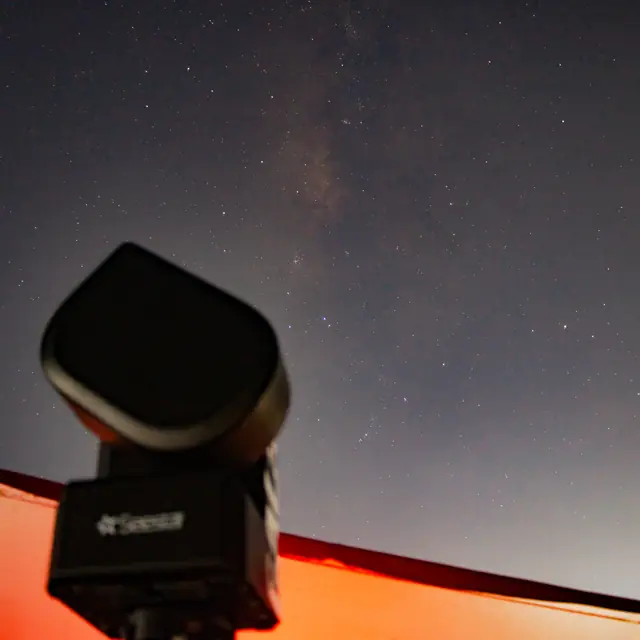
- A camera: A 14-24 mm lens on a tripod, 10-20 s exposures, from a dark site.
How big, how bright, how far
- Distance: 26,000 light-years. The light reaching your eye left it about 26,000 years ago.
What it is made of
- Type
- Galaxy Feature (Galactic Center)
- Distance
- Approx. 26,000 Lightyears
- True size
- Vast region, core few parsecs
- Sagittarius A* (SMBH): Supermassive black hole, ~4 million solar masses
- Dense Star Clusters: Nuclear Star Cluster, Arches Cluster, Quintuplet Cluster
- Gas and Dust Clouds: Obscure visible light, studied in infrared/radio
- Magnetic Fields & Cosmic Rays: Complex dynamics and high-energy particles
More deep-sky objects: Butterfly Cluster (M6) · Ptolemy Cluster (M7) · Lagoon Nebula (M8) · Trifid Nebula (M20) · Globular Cluster M22 · M25 (Open Cluster IC 4725)