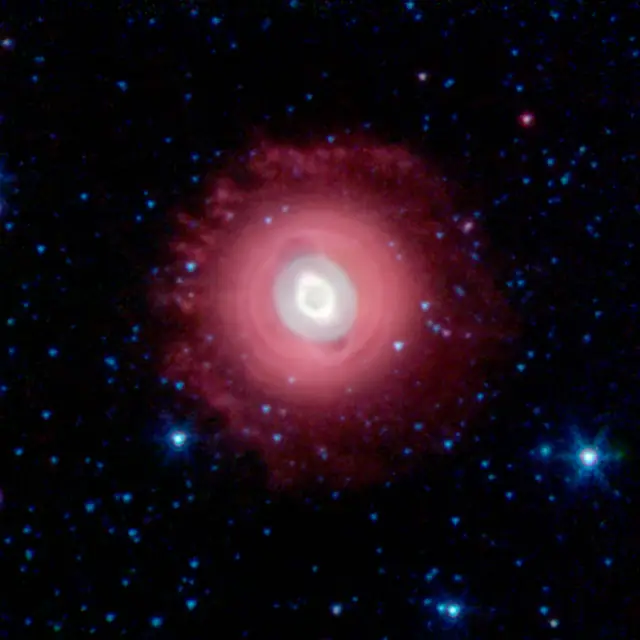
Ghost of Jupiter (NGC 3242)
A bright planetary nebula in Hydra, often showing a bluish-green hue and a visible central star. Its apparent size and brightness in a small telescope can resemble the planet Jupiter, hence the name.
Planetary nebula in Hydra. Magnitude 8.6.
Can you see it from Guyana?
From Georgetown (6.8° N) it climbs to 64° above the southern horizon at its highest; from Lethem (3.4° N), to 68° above the southern horizon. It is highest at midnight on the night of 24 Feb, in the middle of its season. The page works out tonight's rise, highest point and set for both towns in Guyana time (UTC-4), and where the Moon is.
What you'll see
- Your eyes: Not visible to the eye.
- 10x50 binoculars: Looks like a faint star; it needs a telescope.
- A small telescope (80 to 100 mm): A small bright disc at 100x or more, often blue-green.
- A camera: Tiny on camera: it needs 2,000 mm or more of focal length on a tracking mount.
How big, how bright, how far
- Size on the sky: 25″, 1/75 of the Moon's width (the Moon is about 31′ wide).
- Brightness: magnitude 8.6. Fainter than the faintest stars in Georgetown (4.3) and Lethem (6.0): binoculars or a telescope.
- Distance: 4,400 light-years. The light reaching your eye left it about 4,400 years ago.
- True size: 0.53 light-years across its catalogued outline; light crosses it in 6 months.
Apparent size from OpenNGC (Mattia Verga), CC-BY-SA-4.0.
What it is made of
- Type
- Planetary Nebula
What is in it, not measured:
- Ionized Oxygen (OIII): Dominant blue-green emission
- Ionized Hydrogen (H-alpha): Fainter reddish halo
- Central White Dwarf: Hot remnant star
How we know: Distance from Gaia parallax of its central star: Gaia EDR3 parallax of the central star (SIMBAD basic.plx_value, 2020yCat.1350....0G), distance = 1/parallax, retrieved 2026-10-21 (0.7452 +/- 0.0502 mas). True size: the apparent size times the distance (apparent size: OpenNGC (Verga, CC-BY-SA-4.0) commit 75ca7ff; HEASARC plnebulae (Acker et al. 1992) (NGC3242)).
More deep-sky objects: Eight-Burst Nebula (NGC 3132) · Blue Planetary (NGC 3918) · Statue of Liberty Nebula (NGC 3576) · Thor's Helmet (NGC 2359) · Seagull Nebula (IC 2177) · Coalsack Nebula