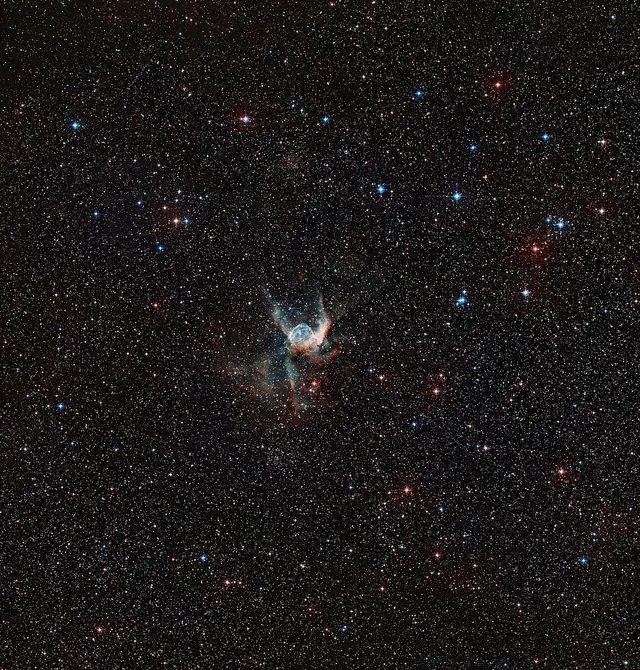
Thor's Helmet (NGC 2359)
A bubble of gas in Canis Major, blown by WR 7, a Wolf-Rayet star near the end of its life. The star is far: about 16,000 light-years, so the bubble is about 100 light-years wide.
Emission nebula in Canis Major.
Can you see it from Guyana?
From Georgetown (6.8° N) it climbs to 70° above the southern horizon at its highest; from Lethem (3.4° N), to 73° above the southern horizon. It is highest at midnight on the night of 7 Jan, in the middle of its season. The page works out tonight's rise, highest point and set for both towns in Guyana time (UTC-4), and where the Moon is.
What you'll see
- Your eyes: Not visible to the eye. It lies 8.8° east of Sirius.
- 10x50 binoculars: Not visible in binoculars.
- A small telescope (80 to 100 mm): With an OIII filter, a faint ring with two "wings"; without one, only a hint.
- A camera: Spans about 40% of an APS-C frame at 1,500 mm (field 0.9° × 0.6°); needs a tracking mount. An H-alpha-sensitive (modified) camera brings out its red glow.
How big, how bright, how far
- Size on the sky: 22′, 71% of the Moon's width (the Moon is about 31′ wide).
- Distance: 16,000 light-years. The light reaching your eye left it about 16,000 years ago.
- True size: 100 light-years across its catalogued outline; light crosses it in 100 years.
What it is made of
- Type
- Wind-blown nebula
What is in it, not measured:
- Gas thrown off by a massive star: in its fierce stellar wind
- Swept-up gas: from around the star
- The Wolf-Rayet star itself: hot, and losing mass fast
How we know: Distance from the Gaia parallax of WR 7, the Wolf-Rayet star that blows it: Gaia EDR3 parallax via SIMBAD (basic.plx_value, 2020yCat.1350....0G), distance = 1/parallax, retrieved 2026-10-21 (HD 56925: 0.2096 +/- 0.0268 mas). True size: the apparent size times the distance (apparent size: Sharpless 1959, ApJS 4, 257 (VizieR VII/20), Sh2-298).
More deep-sky objects: Seagull Nebula (IC 2177) · Hubble's Variable Nebula (NGC 2261) · M78 (Reflection Nebula) · Horsehead Nebula (Barnard 33) · Flame Nebula (NGC 2024) · De Mairan's Nebula (M43)