De Mairan's Nebula (M43)
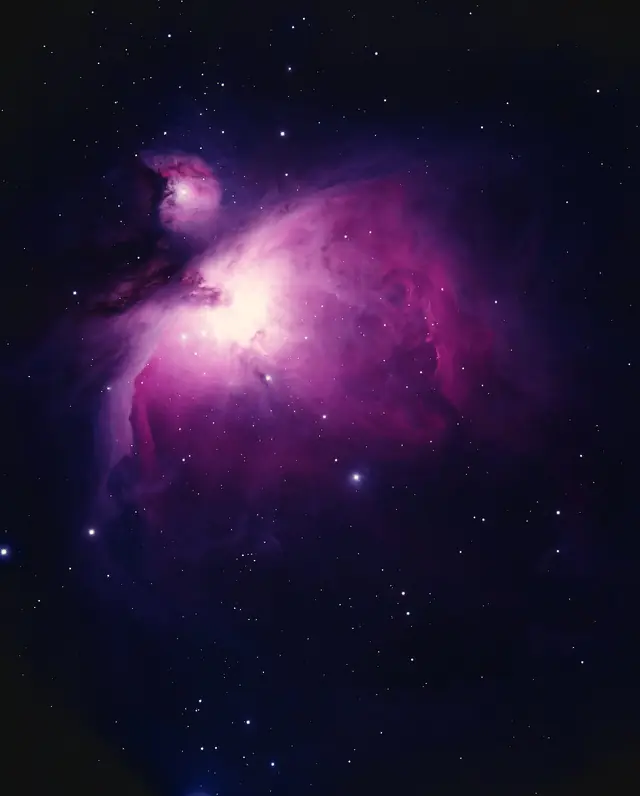
A small, rounder part of the Orion Nebula complex, 0.2° north-east of M42. One star, NU Orionis, lights it; Gaia puts that star about 1,360 light-years away.
Emission nebula in Orion.
Can you see it from Guyana?
From Georgetown (6.8° N) it climbs to 78° above the southern horizon at its highest; from Lethem (3.4° N), to 81° above the southern horizon. It is highest at midnight on the night of 12 Dec, in the middle of its season. The page works out tonight's rise, highest point and set for both towns in Guyana time (UTC-4), and where the Moon is.
What you'll see
- Your eyes: Not visible to the eye on its own: it sits in the glow of the Orion Nebula.
- 10x50 binoculars: A small knot beside the Orion Nebula, from a dark site.
- A small telescope (80 to 100 mm): A small glow around one star, just north-east of M42; a UHC filter helps.
- A camera: Spans about 40% of an APS-C frame at 1,500 mm (field 0.9° × 0.6°); needs a tracking mount. An H-alpha-sensitive (modified) camera brings out its red glow. It fits in the Orion Nebula's own frame.
How big, how bright, how far
- Size on the sky: 20′ × 15′, 64% of the Moon's width (the Moon is about 31′ wide).
- Distance: 1,360 light-years. The light reaching your eye left it about 1,360 years ago, around the year 670.
- True size: 7.9 light-years across its catalogued outline; light crosses it in 7.9 years.
Apparent size from OpenNGC (Mattia Verga), CC-BY-SA-4.0.
What it is made of
- Type
- Emission nebula
What is in it, not measured:
- Ionised hydrogen: glows red where hot stars light it
- Helium and heavier gases: with traces of oxygen, nitrogen and sulphur
- Dust: in dark lanes
- Young hot stars: that light it
How we know: Distance from the Gaia parallax of NU Orionis (HD 37061), the star that lights it: Gaia EDR3 parallax via SIMBAD (basic.plx_value, 2020yCat.1350....0G), distance = 1/parallax, retrieved 2026-10-21 (HD 37061: 2.4059 +/- 0.0585 mas). True size: the apparent size times the distance (apparent size: OpenNGC (Mattia Verga, CC BY-SA 4.0), commit 4e2398a2).
More deep-sky objects: Horsehead Nebula (Barnard 33) · Flame Nebula (NGC 2024) · M78 (Reflection Nebula) · Hubble's Variable Nebula (NGC 2261) · Seagull Nebula (IC 2177) · Thor's Helmet (NGC 2359)