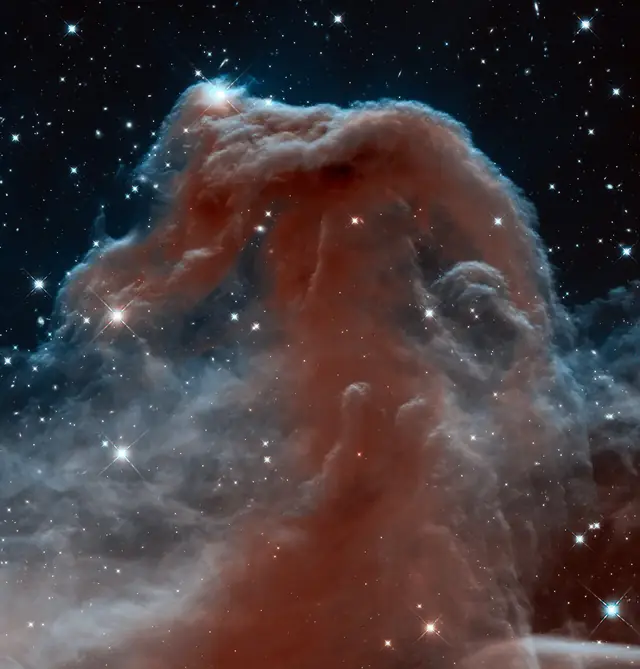
Horsehead Nebula (Barnard 33)
A famous dark nebula in Orion, silhouetted against the bright emission nebula IC 434. It is notoriously difficult to observe visually and requires a telescope, often with an H-beta filter, under very dark skies.
Dark nebula in Orion.
Can you see it from Guyana?
From Georgetown (6.8° N) it climbs to 81° above the southern horizon at its highest; from Lethem (3.4° N), to 84° above the southern horizon. It is highest at midnight on the night of 14 Dec, in the middle of its season. The page works out tonight's rise, highest point and set for both towns in Guyana time (UTC-4), and where the Moon is.
What you'll see
- Your eyes: Not visible to the eye.
- 10x50 binoculars: Not visible in binoculars.
- A small telescope (80 to 100 mm): Very hard: a dark notch against the faint glow of IC 434, usually needing an H-beta filter and a larger telescope.
- A camera: An easy camera target with a tracking mount at 500-1,000 mm, and an H-alpha-sensitive camera.
How big, how bright, how far
- Size on the sky: 6′ × 4′, 19% of the Moon's width (the Moon is about 31′ wide).
- Distance: 1,400 light-years. The light reaching your eye left it about 1,400 years ago, around the year 630.
- True size: 2.4 light-years across its catalogued outline; light crosses it in 2.4 years.
Apparent size from OpenNGC (Mattia Verga), CC-BY-SA-4.0.
What it is made of
- Type
- Dark Nebula
What is in it, not measured:
- Dense Dust Grains: Silicates and carbonaceous material, blocks visible light
- Molecular Hydrogen (H2): Primary gas component, cold and non-emitting in visible
- Carbon Monoxide (CO): Tracer molecule for radio observations of cold gas
How we know: Distance from radio parallax of its young stars: Orion B: Kounkel et al. 2017, ApJ 834, 142 (VLBA, arXiv:1609.04041): roughly 420 pc towards NGC 2024, beside the Horsehead; Zucker et al. 2020 Orion sightlines nearest it 411-451 pc. True size: the apparent size times the distance (apparent size: OpenNGC (Verga, CC-BY-SA-4.0) commit 75ca7ff; SIMBAD (B033)).
More deep-sky objects: Flame Nebula (NGC 2024) · M78 (Reflection Nebula) · De Mairan's Nebula (M43) · Hubble's Variable Nebula (NGC 2261) · Seagull Nebula (IC 2177) · Thor's Helmet (NGC 2359)