Flame Nebula (NGC 2024)
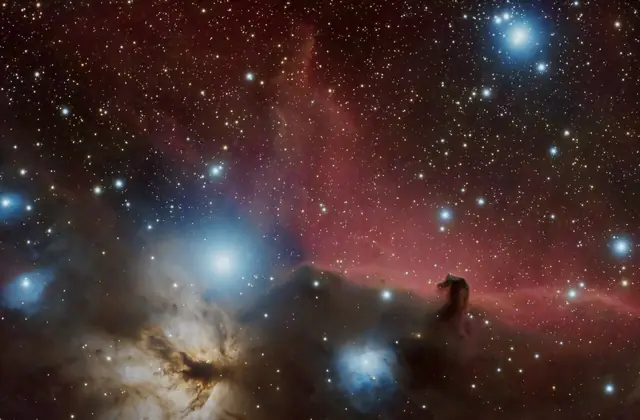
An emission nebula in Orion, illuminated by the bright star Alnitak (Zeta Orionis). Its intricate dark lanes give it a fiery appearance. Challenging visually, often requiring H-beta or OIII filters and very dark skies.
Emission nebula in Orion.
Can you see it from Guyana?
From Georgetown (6.8° N) it climbs to 81° above the southern horizon at its highest; from Lethem (3.4° N), to 85° above the southern horizon. It is highest at midnight on the night of 14 Dec, in the middle of its season. The page works out tonight's rise, highest point and set for both towns in Guyana time (UTC-4), and where the Moon is.
What you'll see
- Your eyes: Not visible to the eye.
- 10x50 binoculars: Not visible in binoculars: it hides in the glare of Alnitak.
- A small telescope (80 to 100 mm): Faint: put Alnitak (the Belt's eastern star) just out of the field to see the dark lane and glow.
- A camera: Spans about 40% of an APS-C frame at 1,000 mm; with the Horsehead nearby, 400-500 mm frames both.
How big, how bright, how far
- Size on the sky: 30′, 96% of the Moon's width (the Moon is about 31′ wide).
- Distance: 900 to 1,500 light-years. The light reaching your eye left it between 900 and 1,500 years ago.
What it is made of
- Type
- Emission Nebula with Dark Dust Lane
- Distance
- Approx. 900 - 1,500 Lightyears
- True size
- Approx. 12 Lightyears across
- Ionized Hydrogen (HII): Glows with orange and reddish hues due to foreground dust and ionization
- Dark Dust Lane: Prominent silhouette against the bright nebula
- Young Star Cluster: Embedded within the nebula, many stars hidden by dust, likely source of ionization
- Alnitak (nearby star): May contribute to ionization, though primary source is likely embedded cluster
More deep-sky objects: Horsehead Nebula (Barnard 33) · M78 (Reflection Nebula) · Eskimo Nebula (NGC 2392 / Clown Face Nebula) · Ghost of Jupiter (NGC 3242) · Little Dumbbell Nebula (M76) · Owl Nebula (M97)