Eskimo Nebula (NGC 2392 / Clown Face Nebula)
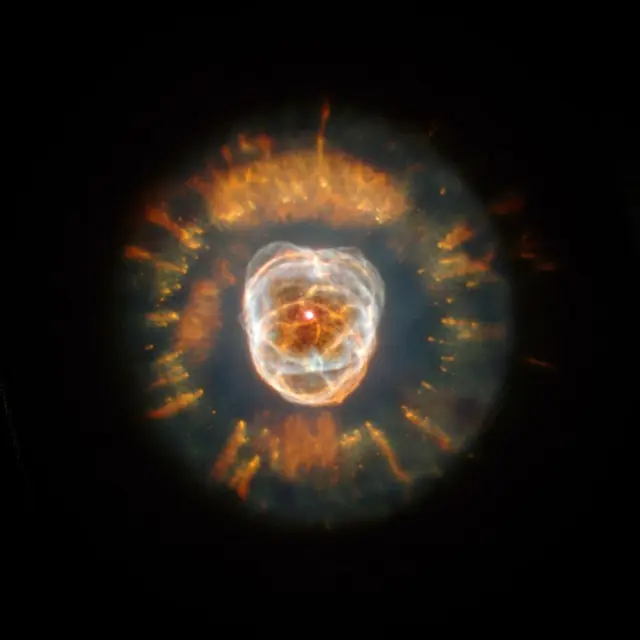
A bright planetary nebula in Gemini, whose appearance through a telescope can resemble a face surrounded by a fur-lined hood (Eskimo) or a clown's face. Responds well to magnification.
Planetary nebula in Gemini. Magnitude 9.1.
Can you see it from Guyana?
From Georgetown (6.8° N) it climbs to 76° above the northern horizon at its highest; from Lethem (3.4° N), to 73° above the northern horizon. It is highest at midnight on the night of 10 Jan, in the middle of its season. The page works out tonight's rise, highest point and set for both towns in Guyana time (UTC-4), and where the Moon is.
What you'll see
- Your eyes: Not visible to the eye.
- 10x50 binoculars: Just detectable in binoculars from a dark site, as a faint smudge.
- A small telescope (80 to 100 mm): A small bright disc at 100x or more, often blue-green.
- A camera: Tiny on camera: it needs 2,000 mm or more of focal length on a tracking mount.
How big, how bright, how far
- Size on the sky: 52″, 1/36 of the Moon's width (the Moon is about 31′ wide).
- Brightness: magnitude 9.1. Fainter than the faintest stars in Georgetown (4.3) and Lethem (6.0): binoculars or a telescope.
- Distance: 6,500 light-years. The light reaching your eye left it about 6,500 years ago.
Apparent size from OpenNGC (Mattia Verga), CC-BY-SA-4.0.
What it is made of
- Type
- Planetary Nebula
- Distance
- Approx. 6,500 Lightyears
- True size
- Approx. 0.6 Lightyears diameter
- Inner Shell (Ionized Oxygen): Bright OIII emission, forms the 'face'
- Outer Filaments (Ionized Hydrogen/Nitrogen): Forms the 'parka hood', reddish
- Central Star: Hot O-type star
More deep-sky objects: M78 (Reflection Nebula) · Flame Nebula (NGC 2024) · Horsehead Nebula (Barnard 33) · Owl Nebula (M97) · Ghost of Jupiter (NGC 3242) · Little Dumbbell Nebula (M76)