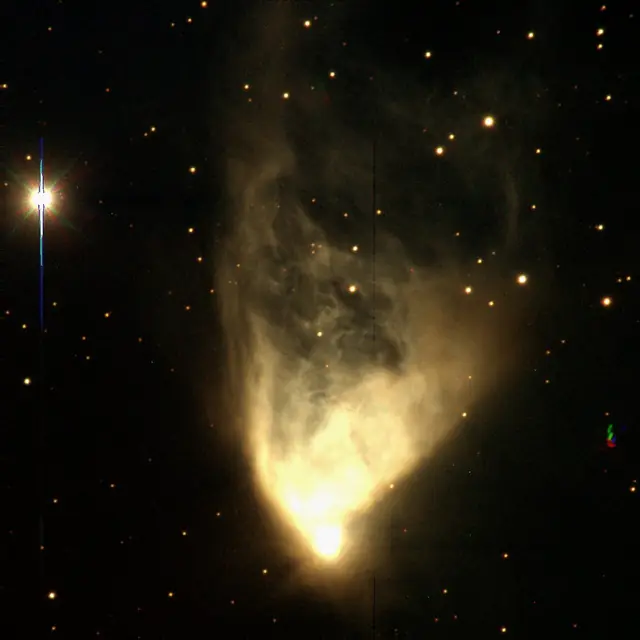
Hubble's Variable Nebula (NGC 2261)
A small fan of dust in Monoceros lit by R Monocerotis, a young star at its tip. It is called variable because its brightness and shape change from one look to the next.
Reflection nebula in Monoceros.
Can you see it from Guyana?
From Georgetown (6.8° N) it climbs to 88°, almost straight overhead at its highest; from Lethem (3.4° N), to 85° above the northern horizon. It is highest at midnight on the night of 28 Dec, in the middle of its season. The page works out tonight's rise, highest point and set for both towns in Guyana time (UTC-4), and where the Moon is.
What you'll see
- Your eyes: Not visible to the eye. It lies 7.7° south of Alhena.
- 10x50 binoculars: Not visible in binoculars.
- A small telescope (80 to 100 mm): A small, bright comet-shaped fan at medium power, with the star at its point.
- A camera: Tiny on camera: it needs 2,000 mm or more of focal length on a tracking mount.
How big, how bright, how far
- Size on the sky: 2′ × 1′, 1/16 of the Moon's width (the Moon is about 31′ wide).
- Distance: 2,400 light-years. The light reaching your eye left it about 2,400 years ago.
- True size: 1.4 light-years across its catalogued outline; light crosses it in 17 months.
Apparent size from OpenNGC (Mattia Verga), CC-BY-SA-4.0.
What it is made of
- Type
- Reflection nebula
What is in it, not measured:
- Dust: scattering a nearby star's light, which is why it looks blue
- Cold gas: that the dust lives in
- A young star: that lights it
How we know: Distance from its neighbourhood: R Monocerotis, the star that lights it, has no Gaia parallax, so the distance is borrowed: borrowed from the young cluster NGC 2264 beside it, as the site's NGC 2264 page gives it: Hunt & Reffert 2024 (Gaia DR3) 700 pc and Zucker et al. 2020 Mon OB1 sightlines 708-796 pc; Manoj et al. 2006 (2006ApJ...653..657M, via SIMBAD) adopt 800 pc for R Mon, which has only a two-parameter Gaia DR3 solution (no parallax). True size: the apparent size times the distance (apparent size: OpenNGC (Mattia Verga, CC BY-SA 4.0), commit 4e2398a2).
More deep-sky objects: M78 (Reflection Nebula) · Eskimo Nebula (NGC 2392 / Clown Face Nebula) · Flame Nebula (NGC 2024) · Horsehead Nebula (Barnard 33) · Seagull Nebula (IC 2177) · De Mairan's Nebula (M43)