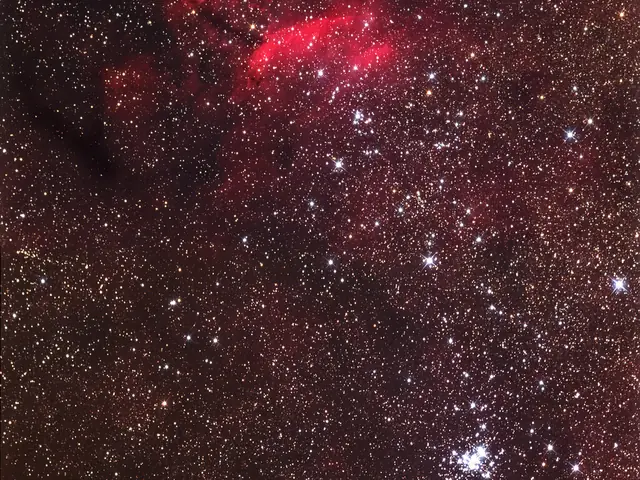
NGC 6231 (Northern Jewel Box)
A very young and brilliant open cluster in Scorpius, visible to the naked eye. With associated nebulosity, it can appear like the head of a comet.
Open cluster in Scorpius. Magnitude 2.6.
Can you see it from Guyana?
From Georgetown (6.8° N) it climbs to 41° above the southern horizon at its highest; from Lethem (3.4° N), to 45° above the southern horizon. It is highest at midnight on the night of 2 Jun, in the middle of its season. The page works out tonight's rise, highest point and set for both towns in Guyana time (UTC-4), and where the Moon is.
What you'll see
- Your eyes: Visible to the eye even from Georgetown, as a hazy knot of stars.
- 10x50 binoculars: Resolves into dozens of stars.
- A small telescope (80 to 100 mm): Dozens to hundreds of stars at low power.
- A camera: Spans about 40% of an APS-C frame at 2,000 mm (field 0.7° × 0.4°); needs a tracking mount.
How big, how bright, how far
- Size on the sky: 15′, 48% of the Moon's width (the Moon is about 31′ wide).
- Brightness: magnitude 2.6. Brighter than the faintest stars Georgetown shows (4.3), and Lethem's (6.0).
- Distance: 5,070 light-years. The light reaching your eye left it about 5,100 years ago.
What it is made of
- Type
- Open cluster
- Distance
- Approx. 5,070 Lightyears
- True size
- Approx. 22 Lightyears across
- Age
- about 4 million years (range 3 million years to 5 million years)
- Notable
- Very young: about 4 million years, younger than all but 74 of the 7,168 clusters in the Gaia DR3 catalogue.
More deep-sky objects: Butterfly Cluster (M6) · Ptolemy Cluster (M7) · Globular Cluster M4 · Globular Cluster M22 · M25 (Open Cluster IC 4725) · Eagle Nebula (M16)