Bug Nebula (NGC 6302)
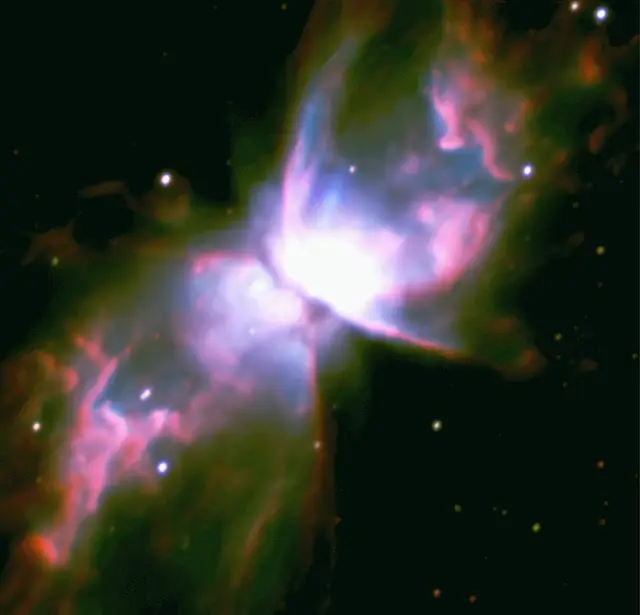
A bipolar planetary nebula in Scorpius, two lobes of gas thrown out from a dying star. Its distance comes from its expansion: knots of gas tracked for 51 years, against their speed, put it about 3,800 light-years away.
Planetary nebula in Scorpius. Magnitude 9.6.
Can you see it from Guyana?
From Georgetown (6.8° N) it climbs to 46° above the southern horizon at its highest; from Lethem (3.4° N), to 50° above the southern horizon. It is highest at midnight on the night of 8 Jun, in the middle of its season. The page works out tonight's rise, highest point and set for both towns in Guyana time (UTC-4), and where the Moon is.
What you'll see
- Your eyes: Not visible to the eye. It lies 3.4° west of Lesath.
- 10x50 binoculars: Just detectable in binoculars from a dark site, as a faint smudge.
- A small telescope (80 to 100 mm): A small, bright glow at high power; an OIII filter brings out its shape.
- A camera: Tiny on camera: it needs 2,000 mm or more of focal length on a tracking mount.
How big, how bright, how far
- Size on the sky: 44″, 1/42 of the Moon's width (the Moon is about 31′ wide).
- Brightness: magnitude 9.6. Fainter than the faintest stars in Georgetown (4.3) and Lethem (6.0): binoculars or a telescope.
- Distance: 3,800 light-years. The light reaching your eye left it about 3,800 years ago.
- True size: 0.81 light-years across its catalogued outline; light crosses it in 10 months.
Apparent size from OpenNGC (Mattia Verga), CC-BY-SA-4.0.
What it is made of
- Type
- Planetary nebula
- Notable
- Its distance is an expansion parallax: 15 knots of gas tracked over 51 years.
What is in it, not measured:
- Ionised gas: thrown off by a dying star: hydrogen, helium, oxygen, nitrogen
- The hot exposed core: becoming a white dwarf
How we know: Distance from its expansion: knots of gas tracked across the sky for 51 years, against their speed: Meaburn et al. 2008, MNRAS 385, 269 (arXiv:0711.4359): 1.17 ± 0.14 kpc. True size: the apparent size times the distance (apparent size: OpenNGC (Mattia Verga, CC BY-SA 4.0), commit 4e2398a2).
More deep-sky objects: Cat's Paw Nebula (NGC 6334) · Coalsack Nebula · Blue Planetary (NGC 3918) · Saturn Nebula (NGC 7009) · Statue of Liberty Nebula (NGC 3576) · Helix Nebula (NGC 7293)