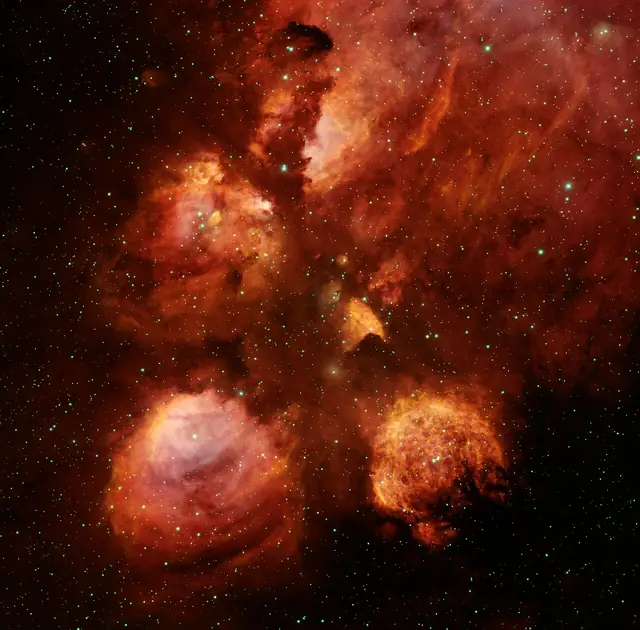
Cat's Paw Nebula (NGC 6334)
A star-forming cloud of glowing gas in Scorpius, 2.3° from Lesath. Dust in the plane of the Milky Way reddens its colours, and it shares one cloud complex with the War and Peace Nebula.
Emission nebula in Scorpius.
Can you see it from Guyana?
From Georgetown (6.8° N) it climbs to 47° above the southern horizon at its highest; from Lethem (3.4° N), to 51° above the southern horizon. It is highest at midnight on the night of 9 Jun, in the middle of its season. The page works out tonight's rise, highest point and set for both towns in Guyana time (UTC-4), and where the Moon is.
What you'll see
- Your eyes: Not visible to the eye. It lies 2.3° north-west of Lesath.
- 10x50 binoculars: Hard: a faint glow from a dark site with a nebula filter.
- A small telescope (80 to 100 mm): Very faint: a dark site and a UHC or OIII filter show patches of its glow.
- A camera: Spans about 40% of an APS-C frame at 600 mm (field 2.2° × 1.5°); needs a tracking mount. An H-alpha-sensitive (modified) camera brings out its red glow.
How big, how bright, how far
- Size on the sky: 50′ × 25′, 1.6 Moons across (the Moon is about 31′ wide).
- Distance: 5,400 light-years. The light reaching your eye left it about 5,400 years ago.
- True size: 79 light-years across its catalogued outline; light crosses it in 79 years.
What it is made of
- Type
- Emission nebula
- Notable
- A star-forming region whose colours are reddened by dust in the plane of the Milky Way.
What is in it, not measured:
- Ionised hydrogen: glows red where hot stars light it
- Helium and heavier gases: with traces of oxygen, nitrogen and sulphur
- Dust: in dark lanes
- Young hot stars: that light it
How we know: Distance from Gaia parallaxes of the young stars of the cloud complex it shares with NGC 6357: Povich et al. 2026 (arXiv:2604.15050): the G352 complex joining NGC 6357 and NGC 6334, 1,670 ± 80 pc. True size: the apparent size times the distance (apparent size: Rodgers, Campbell & Whiteoak 1960, MNRAS 121, 103 (VizieR VII/216), RCW 127).
More deep-sky objects: Bug Nebula (NGC 6302) · Coalsack Nebula · Saturn Nebula (NGC 7009) · Blue Planetary (NGC 3918) · Statue of Liberty Nebula (NGC 3576) · Helix Nebula (NGC 7293)