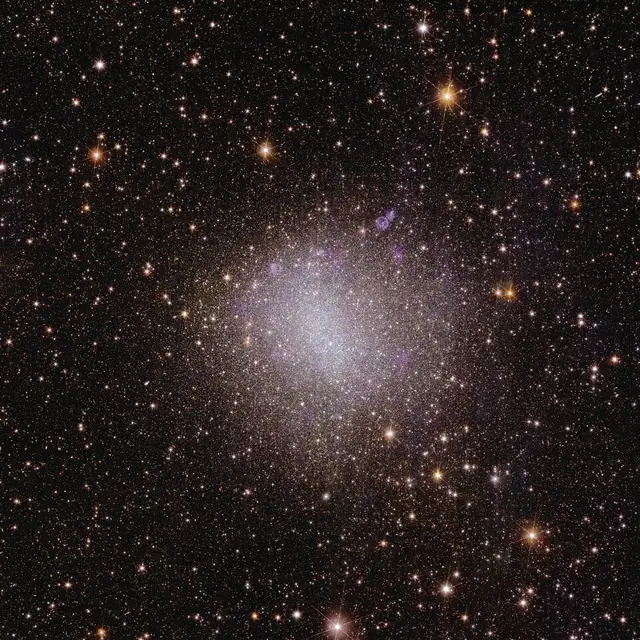
Barnard's Galaxy (NGC 6822)
An irregular dwarf galaxy in Sagittarius, a member of the Local Group. It has a low surface brightness and is a challenging telescopic object, appearing as a large, faint glow with some brighter knots (HII regions) best seen under very dark skies.
Galaxy in Sagittarius. Magnitude 9.3.
Can you see it from Guyana?
From Georgetown (6.8° N) it climbs to 68° above the southern horizon at its highest; from Lethem (3.4° N), to 72° above the southern horizon. It is highest at midnight on the night of 16 Jul, in the middle of its season. The page works out tonight's rise, highest point and set for both towns in Guyana time (UTC-4), and where the Moon is.
What you'll see
- Your eyes: Not visible to the eye.
- 10x50 binoculars: Not visible in binoculars.
- A small telescope (80 to 100 mm): Very faint: a dark site, low power and patience.
- A camera: Spans about 40% of an APS-C frame at 2,000 mm (field 0.7° × 0.4°); needs a tracking mount.
How big, how bright, how far
- Size on the sky: 17′, 55% of the Moon's width (the Moon is about 31′ wide).
- Brightness: magnitude 9.3. Fainter than the faintest stars in Georgetown (4.3) and Lethem (6.0): binoculars or a telescope.
- Distance: 1.6 million light-years. The light reaching your eye left it about 1.6 million years ago.
- True size: 7,700 light-years across its catalogued outline; light crosses it in 7,700 years.
Apparent size from OpenNGC (Mattia Verga), CC-BY-SA-4.0.
What it is made of
- Type
- Barred Irregular Dwarf Galaxy
What is in it, not measured:
- Stars: Irregular distribution, some clusters
- HII Regions: Several prominent star-forming nebulae
- Gas and Dust: Relatively rich for its size
How we know: Distance from Cepheid variable stars and its brightest red giants: NED-D median of 127 redshift-independent estimates, 0.479 Mpc (Cepheid median 0.474, TRGB median 0.5025), retrieved 2026-10-21. True size: the apparent size times the distance (apparent size: OpenNGC (Verga, CC-BY-SA-4.0) commit 75ca7ff; HyperLEDA (NGC6822)).
More deep-sky objects: NGC 55 (Galaxy) · NGC 7331 (Galaxy) · Sculptor Galaxy (NGC 253) · NGC 300 (Galaxy) · NGC 247 (Galaxy) · Small Magellanic Cloud (SMC)