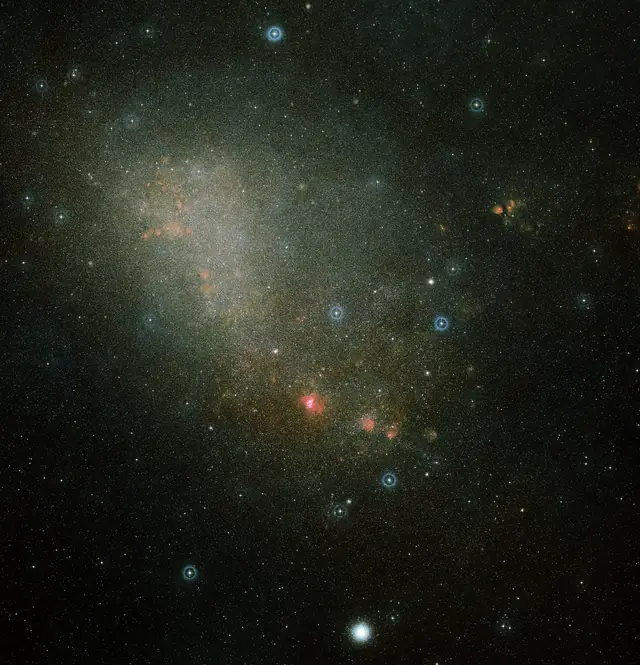
Small Magellanic Cloud (SMC)
A smaller satellite galaxy of the Milky Way. From Guyana it stays very low: at its best about 11° above the southern horizon from Georgetown and about 14° from Lethem. It is a small, faint smudge, so it needs a dark site, a clear southern horizon and a moonless night; from towns it is usually lost in the glow and haze.
Galaxy in Tucana. Magnitude 2.7.
Can you see it from Guyana?
From Georgetown (6.8° N) it climbs to 11° above the southern horizon at its highest; from Lethem (3.4° N), to 14° above the southern horizon. It is highest at midnight on the night of 2 Oct, in the middle of its season. The page works out tonight's rise, highest point and set for both towns in Guyana time (UTC-4), and where the Moon is.
What you'll see
- Your eyes: Visible to the eye from a dark site as a small detached cloud of the Milky Way. From Guyana it only reaches 11° above the southern horizon.
- 10x50 binoculars: Sweep it for star clouds; the globular 47 Tucanae sits just beside it.
- A small telescope (80 to 100 mm): Clusters and nebulae inside it, dimmed by low haze from Guyana.
- A camera: Spans about 40% of an APS-C frame at 135 mm (field 9.9° × 6.6°); needs a tracking mount.
How big, how bright, how far
- Size on the sky: 300′ × 180′, 9.6 Moons across (the Moon is about 31′ wide).
- Brightness: magnitude 2.7. Brighter than the faintest stars Georgetown shows (4.3), and Lethem's (6.0).
- Distance: 200,000 light-years. The light reaching your eye left it about 200,000 years ago.
Apparent size from OpenNGC (Mattia Verga), CC-BY-SA-4.0.
What it is made of
- Type
- Dwarf Galaxy
- Distance
- Approx. 200,000 Lightyears
- True size
- Approx. 7,000 Lightyears diameter
- Stars (Millions to Billions): Mix of stellar populations, open clusters
- Interstellar Gas & Dust: Less prominent than LMC but present
- Dark Matter: Significant component
.jpg)
More deep-sky objects: Large Magellanic Cloud (LMC) · Sculptor Galaxy (NGC 253) · Centaurus A (NGC 5128) · Barnard's Galaxy (NGC 6822) · M77 (Cetus A) · Southern Pinwheel Galaxy (M83)