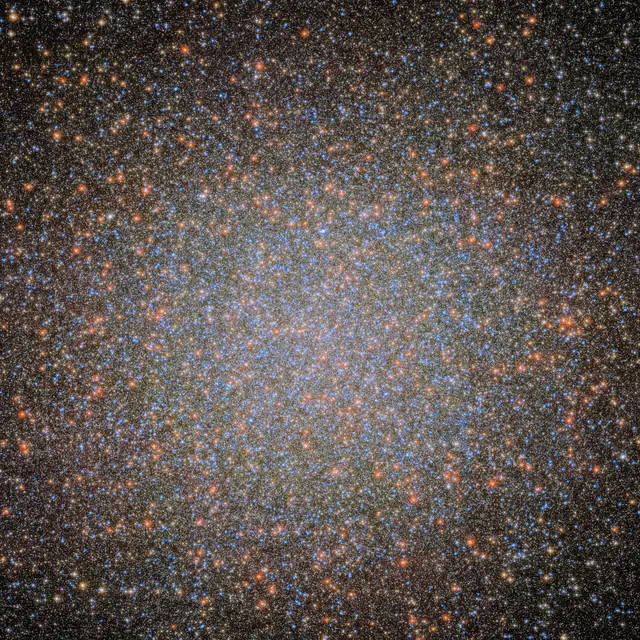
Omega Centauri (NGC 5139)
The largest globular cluster in the Milky Way, visible to the naked eye and appearing nearly as large as the full moon.
Globular cluster in Centaurus. Magnitude 3.9.
Can you see it from Guyana?
From Georgetown (6.8° N) it climbs to 36° above the southern horizon at its highest; from Lethem (3.4° N), to 39° above the southern horizon. It is highest at midnight on the night of 11 Apr, in the middle of its season. The page works out tonight's rise, highest point and set for both towns in Guyana time (UTC-4), and where the Moon is.
What you'll see
- Your eyes: Visible to the eye from a dark site as a fuzzy star, low in the south: it reaches 36° from Georgetown (39° from Lethem).
- 10x50 binoculars: A round glow, brighter towards the middle.
- A small telescope (80 to 100 mm): The finest globular in the sky: even a small telescope resolves hundreds of its stars.
- A camera: Spans about 40% of an APS-C frame at 800 mm (field 1.7° × 1.1°); needs a tracking mount.
How big, how bright, how far
- Size on the sky: 36′, 1.2 Moons across (the Moon is about 31′ wide).
- Brightness: magnitude 3.9. Brighter than the faintest stars Georgetown shows (4.3), and Lethem's (6.0).
- Distance: 17,090 light-years. The light reaching your eye left it about 17,000 years ago.
What it is made of
- Type
- Globular Cluster (possibly core of dwarf galaxy)
- Distance
- Approx. 17,090 Lightyears
- True size
- Approx. 150 Lightyears diameter
- Old Stars (Millions): Largest globular cluster in Milky Way, multiple generations
- Intermediate-Age Stars: Unusual for globular clusters, suggests complex history
- Minimal Gas and Dust: Largely devoid of star-forming material
More deep-sky objects: Jewel Box Cluster (NGC 4755) · Wishing Well Cluster (NGC 3532) · Southern Pleiades (IC 2602) · NGC 6231 (Northern Jewel Box) · Globular Cluster M4 · IC 2391 (Omicron Velorum Cluster)