M40 (Double Star)
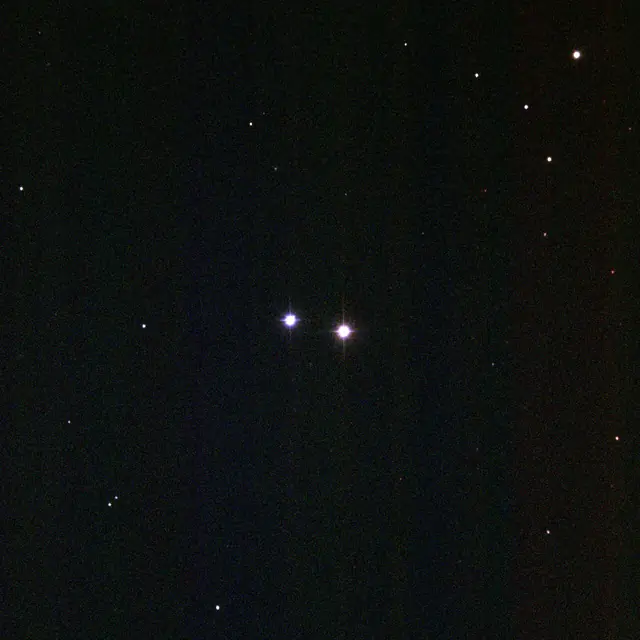
Not a deep-sky object at all: hunting for a nebula Hevelius had reported in error, Messier listed a pair of stars in Ursa Major, 53 arcseconds apart. Gaia shows they are not even a pair: one is about 470 light-years away, the other about 1,000.
Asterism in Ursa Major. Magnitude 8.0.
Can you see it from Guyana?
From Georgetown (6.8° N) it climbs to 39° above the northern horizon at its highest; from Lethem (3.4° N), to 35° above the northern horizon. It is highest at midnight on the night of 25 Mar, in the middle of its season. The page works out tonight's rise, highest point and set for both towns in Guyana time (UTC-4), and where the Moon is.
What you'll see
- Your eyes: Not visible to the eye. It lies 4.8° north-west of Alioth.
- 10x50 binoculars: Two faint stars side by side, hard to split in 10x50 binoculars.
- A small telescope (80 to 100 mm): Two stars 53″ apart, split at low power; that is all M40 is.
- A camera: Two stars on any long-focus frame; a 1,000 mm lens or longer shows them apart.
How big, how bright, how far
- Brightness: magnitude 8.0. Fainter than the faintest stars in Georgetown (4.3) and Lethem (6.0): binoculars or a telescope.
- Distance: Between about 470 and 1,000 light-years. The light reaching your eye left it between about 470 and 1,000 years ago.
What it is made of
- Type
- Double star (a chance pair)
- Notable
- A chance line-up: Gaia DR3 puts one star at about 470 light-years and the other at about 1,000, more than twice as far.
What is in it, not measured:
- Unrelated stars: that only line up from where we stand
How we know: Distance from the Gaia parallax of each of its two stars: Gaia DR3 (VizieR I/355/gaiadr3), distance = 1/parallax, retrieved 2026-10-21: Gaia DR3 1575047353068482688 (G 9.47) 3.2191 ± 0.0118 mas; Gaia DR3 1575047731026006528 (G 10.02) 6.9328 ± 0.0155 mas. True size: Not one object (two stars at different distances), a chance pair of unrelated stars, not one object; Gaia DR3 parallaxes, see distance.
More deep-sky objects: Brocchi's Cluster (Coathanger) · M73 (Asterism) · M109 (Galaxy) · Owl Nebula (M97) · M108 (Galaxy) · Galaxy M106