NGC 2403 (Galaxy)
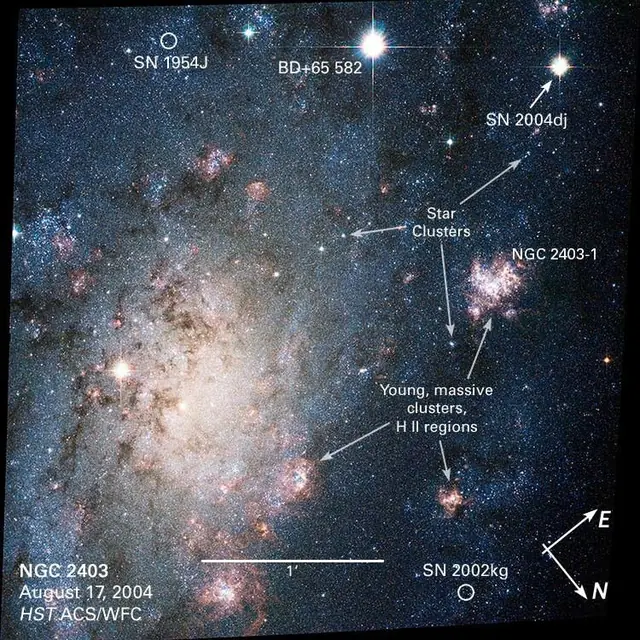
A relatively bright intermediate spiral galaxy in Camelopardalis, similar in appearance and distance to M33. Visible as an elongated smudge in good binoculars under dark skies, small telescopes reveal more.
Galaxy in Camelopardis. Magnitude 8.9.
Can you see it from Guyana?
From Georgetown (6.8° N) it climbs to 31° above the northern horizon at its highest; from Lethem (3.4° N), to 28° above the northern horizon. It is highest at midnight on the night of 12 Jan, in the middle of its season. The page works out tonight's rise, highest point and set for both towns in Guyana time (UTC-4), and where the Moon is.
What you'll see
- Your eyes: Not visible to the eye.
- 10x50 binoculars: A faint smudge from a dark site.
- A small telescope (80 to 100 mm): Faint and diffuse: use low power from a dark site.
- A camera: Spans about 40% of an APS-C frame at 1,500 mm (field 0.9° × 0.6°); needs a tracking mount.
How big, how bright, how far
- Size on the sky: 20′ × 10′, 64% of the Moon's width (the Moon is about 31′ wide).
- Brightness: magnitude 8.9. Fainter than the faintest stars in Georgetown (4.3) and Lethem (6.0): binoculars or a telescope.
- Distance: 8 million light-years. The light reaching your eye left it about 8 million years ago.
Apparent size from OpenNGC (Mattia Verga), CC-BY-SA-4.0.
What it is made of
- Type
- Intermediate Spiral Galaxy
- Distance
- Approx. 8 million Lightyears
- True size
- Approx. 50,000 Lightyears diameter
- Stars (Billions): Well-defined spiral arms, small central bulge
- HII Regions: Numerous bright, pink regions of star birth
- Dust Lanes: Trace the spiral structure
More deep-sky objects: Cigar Galaxy (M82) · Bode's Galaxy (M81) · Galaxy M106 · Pinwheel Galaxy (M101) · Whirlpool Galaxy (M51) · NGC 891 (Edge-on Galaxy)