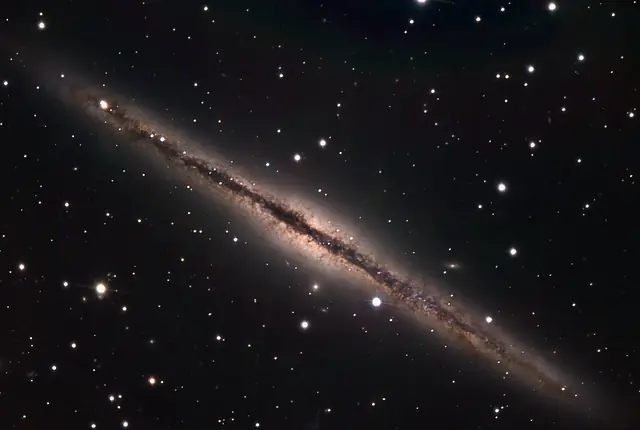
NGC 891 (Edge-on Galaxy)
A beautiful edge-on spiral galaxy in Andromeda, often compared to a fainter version of the Sombrero Galaxy. Its prominent dust lane bisecting the galactic bulge requires a moderate telescope to see well.
Galaxy in Andromeda. Magnitude 9.9.
Can you see it from Guyana?
From Georgetown (6.8° N) it climbs to 54° above the northern horizon at its highest; from Lethem (3.4° N), to 51° above the northern horizon. It is highest at midnight on the night of 25 Oct, in the middle of its season. The page works out tonight's rise, highest point and set for both towns in Guyana time (UTC-4), and where the Moon is.
What you'll see
- Your eyes: Not visible to the eye.
- 10x50 binoculars: Just detectable in binoculars from a dark site, as a faint smudge.
- A small telescope (80 to 100 mm): Faint and diffuse: use low power from a dark site.
- A camera: Spans about 40% of an APS-C frame at 2,000 mm (field 0.7° × 0.4°); needs a tracking mount.
How big, how bright, how far
- Size on the sky: 13′ × 3′, 42% of the Moon's width (the Moon is about 31′ wide).
- Brightness: magnitude 9.9. Fainter than the faintest stars in Georgetown (4.3) and Lethem (6.0): binoculars or a telescope.
- Distance: 30 million light-years. The light reaching your eye left it about 30 million years ago.
- True size: 110,000 light-years across its catalogued outline; light crosses it in 110,000 years.
Apparent size from OpenNGC (Mattia Verga), CC-BY-SA-4.0.
What it is made of
- Type
- Spiral galaxy seen edge-on
- Notable
- Seen edge-on, so its disc shows as a thin streak split by dust.
How we know: Distance from its brightest red giants (the tip of the red giant branch): NED redshift-independent distances (NED-D), retrieved 2026-10-02 (Radburn-Smith et al. 2011, ApJS 195, 18, TRGB). True size: the apparent size times the distance (apparent size: OpenNGC (Verga, CC-BY-SA-4.0) commit 75ca7ff; HyperLEDA (NGC0891)).
More deep-sky objects: Triangulum Galaxy (M33) · Andromeda Galaxy (M31) · M32 (Galaxy) · M110 (Galaxy) · M74 (Phantom Galaxy) · M77 (Cetus A)