M74 (Phantom Galaxy)
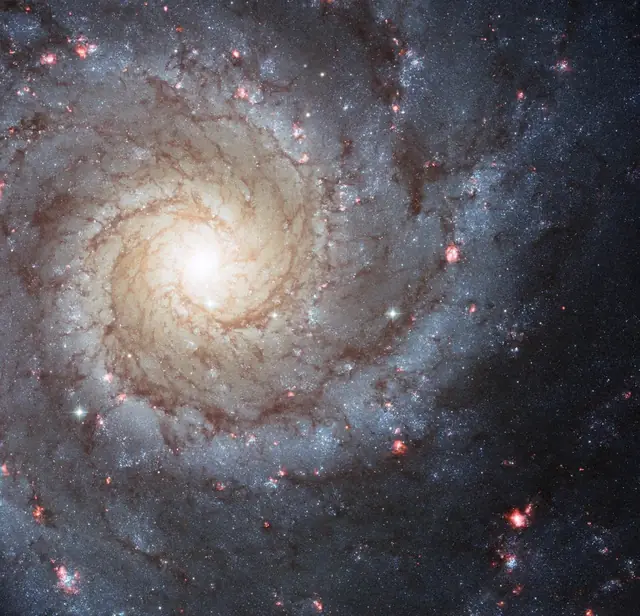
A grand-design face-on spiral galaxy in Pisces. It has a very low surface brightness, making its beautiful spiral arms notoriously challenging to observe visually; requires very dark skies and a good telescope.
Galaxy in Pisces. Magnitude 9.4.
Can you see it from Guyana?
From Georgetown (6.8° N) it climbs to 81° above the northern horizon at its highest; from Lethem (3.4° N), to 77° above the northern horizon. It is highest at midnight on the night of 13 Oct, in the middle of its season. The page works out tonight's rise, highest point and set for both towns in Guyana time (UTC-4), and where the Moon is.
What you'll see
- Your eyes: Not visible to the eye.
- 10x50 binoculars: Hard: only from a dark site.
- A small telescope (80 to 100 mm): Faint and diffuse: one of the hardest Messier objects; a dark site and low power.
- A camera: Tiny on camera: it needs 2,000 mm or more of focal length on a tracking mount.
How big, how bright, how far
- Size on the sky: 10′ × 9′, 32% of the Moon's width (the Moon is about 31′ wide).
- Brightness: magnitude 9.4. Fainter than the faintest stars in Georgetown (4.3) and Lethem (6.0): binoculars or a telescope.
- Distance: 32 million light-years. The light reaching your eye left it about 32 million years ago.
What it is made of
- Type
- Face-on Spiral Galaxy
- Distance
- Approx. 32 million Lightyears
- True size
- Approx. 95,000 Lightyears diameter
- Stars (Billions): Well-defined, symmetric spiral arms
- HII Regions: Many star-forming regions along arms
- Dust Lanes: Trace the spiral pattern
More deep-sky objects: Triangulum Galaxy (M33) · M77 (Cetus A) · Andromeda Galaxy (M31) · NGC 891 (Edge-on Galaxy) · Sculptor Galaxy (NGC 253) · NGC 2403 (Galaxy)