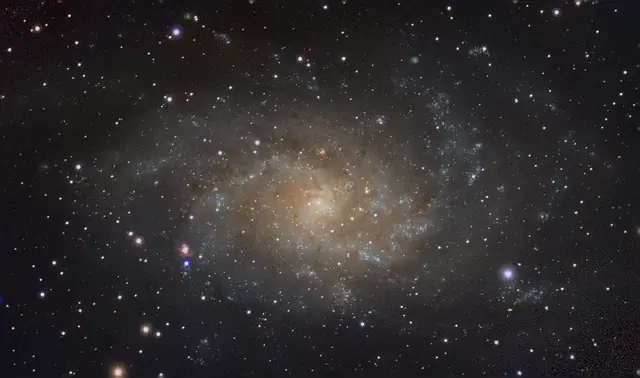
Triangulum Galaxy (M33)
A spiral galaxy that is the third-largest member of the Local Group. Visible under exceptionally dark skies with the naked eye, and a good binocular target.
Galaxy in Triangulum. Magnitude 5.7.
Can you see it from Guyana?
From Georgetown (6.8° N) it climbs to 66° above the northern horizon at its highest; from Lethem (3.4° N), to 63° above the northern horizon. It is highest at midnight on the night of 12 Oct, in the middle of its season. The page works out tonight's rise, highest point and set for both towns in Guyana time (UTC-4), and where the Moon is.
What you'll see
- Your eyes: Only from a very dark site, as a large, faint glow; invisible from towns.
- 10x50 binoculars: A faint smudge from a dark site.
- A small telescope (80 to 100 mm): Faint and diffuse: use low power from a dark site; binoculars often show it better.
- A camera: Spans about 40% of an APS-C frame at 500 mm (field 2.7° × 1.8°); needs a tracking mount.
How big, how bright, how far
- Size on the sky: 62′ × 39′, 2.0 Moons across (the Moon is about 31′ wide).
- Brightness: magnitude 5.7. Fainter than Georgetown's faintest stars (4.3) but brighter than Lethem's (6.0).
- Distance: 2.8 million light-years. The light reaching your eye left it about 2.8 million years ago.
- True size: 51,000 light-years across its catalogued outline; light crosses it in 51,000 years.
What it is made of
- Type
- Galaxy
What is in it, not measured:
- Spiral Arms: Rich in HII regions, multiple star clusters
- Central Core: Modest bulge, older stars
- Dark Matter Halo: Exerts gravitational influence
How we know: Distance from Cepheid variable stars and its brightest red giants: NED-D median of 137 redshift-independent estimates, 0.859 Mpc (Cepheid median 0.839, TRGB median 0.895), retrieved 2026-10-21. True size: the apparent size times the distance (apparent size: HEASARC messier table (Sky Catalogue 2000.0, Hirshfeld & Sinnott 1985), via HEASARC TAP 2026-10-02 (M33)).
More deep-sky objects: M32 (Galaxy) · Andromeda Galaxy (M31) · M74 (Phantom Galaxy) · NGC 891 (Edge-on Galaxy) · M110 (Galaxy) · M77 (Cetus A)