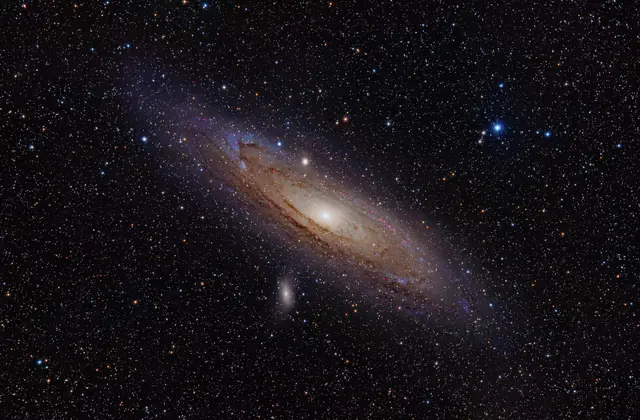
Andromeda Galaxy (M31)
The nearest major spiral galaxy to the Milky Way, visible as a faint smudge to the naked eye under dark skies.
Galaxy in Andromeda. Magnitude 3.4.
Can you see it from Guyana?
From Georgetown (6.8° N) it climbs to 55° above the northern horizon at its highest; from Lethem (3.4° N), to 52° above the northern horizon. It is highest at midnight on the night of 29 Sep, in the middle of its season. The page works out tonight's rise, highest point and set for both towns in Guyana time (UTC-4), and where the Moon is.
What you'll see
- Your eyes: Visible to the eye from a dark site as a long, faint smudge; from Georgetown at best its core.
- 10x50 binoculars: A long oval glow with a bright core; its companion M32 shows as a fuzzy star.
- A small telescope (80 to 100 mm): A bright core in a long oval halo, with companions M32 and M110; spiral arms need a larger telescope.
- A camera: Spans about 40% of an APS-C frame at 200 mm (field 6.7° × 4.5°); needs a tracking mount.
How big, how bright, how far
- Size on the sky: 190′ × 60′, 6.1 Moons across (the Moon is about 31′ wide).
- Brightness: magnitude 3.4. Brighter than the faintest stars Georgetown shows (4.3), and Lethem's (6.0).
- Distance: 2.5 million light-years. The light reaching your eye left it about 2.5 million years ago.
What it is made of
- Type
- Galaxy
- Distance
- Approx. 2.537 million Lightyears
- True size
- Approx. 220,000 Lightyears diameter
- Stars (Trillions): Population I & II stars, central bulge, spiral arms
- Interstellar Gas & Dust: Fuel for star formation, obscuring lanes
- Dark Matter Halo: Dominates mass, inferred gravitationally
.jpg)
More deep-sky objects: Triangulum Galaxy (M33) · NGC 891 (Edge-on Galaxy) · M74 (Phantom Galaxy) · M77 (Cetus A) · NGC 2403 (Galaxy) · Cigar Galaxy (M82)