M32 (Galaxy)
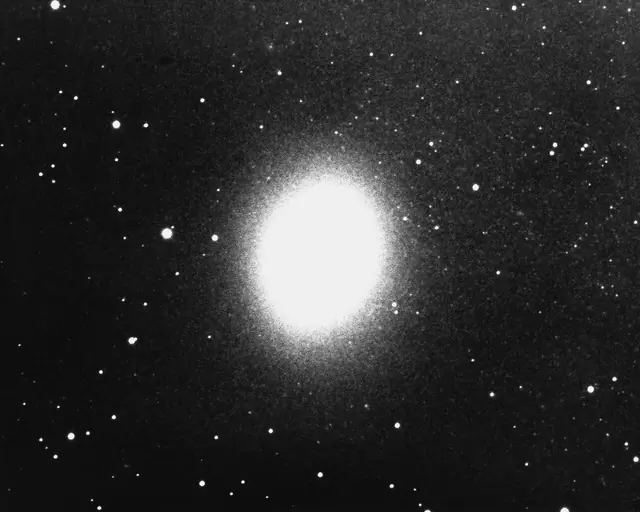
A small, dense elliptical galaxy just 0.4° from the core of the Andromeda Galaxy, one of its satellites. In a telescope it looks like a fuzzy star beside M31's bright centre.
Galaxy in Andromeda. Magnitude 8.1.
Can you see it from Guyana?
From Georgetown (6.8° N) it climbs to 56° above the northern horizon at its highest; from Lethem (3.4° N), to 52° above the northern horizon. It is highest at midnight on the night of 29 Sep, in the middle of its season. The page works out tonight's rise, highest point and set for both towns in Guyana time (UTC-4), and where the Moon is.
What you'll see
- Your eyes: Not visible to the eye. It lies 7.5° north-west of Mirach.
- 10x50 binoculars: An oval glow with a brighter core. It lies 0.4° from the core of the Andromeda Galaxy.
- A small telescope (80 to 100 mm): A small, bright oval like an out-of-focus star, 0.4° south of the Andromeda Galaxy's core.
- A camera: Tiny on camera: it needs 2,000 mm or more of focal length on a tracking mount. At 200 mm it shares the frame with M31 and M110.
How big, how bright, how far
- Size on the sky: 7.7′ × 4.9′, 25% of the Moon's width (the Moon is about 31′ wide).
- Brightness: magnitude 8.1. Fainter than the faintest stars in Georgetown (4.3) and Lethem (6.0): binoculars or a telescope.
- Distance: 2.3 million light-years. The light reaching your eye left it about 2.3 million years ago.
- True size: 5,300 light-years across its catalogued outline; light crosses it in 5,300 years.
Apparent size from OpenNGC (Mattia Verga), CC-BY-SA-4.0.
What it is made of
- Type
- Compact elliptical galaxy
What is in it, not measured:
- Old stars: mostly old, yellow and red
- Very little cold gas or dust
- Dark matter: inferred from how its stars move
How we know: Distance from its brightest red giants (the tip of the red giant branch): NED-D (NASA/IPAC Extragalactic Database, redshift-independent distances), median of 5 TRGB estimates: 0.72 Mpc, 0.68-0.74 Mpc (16th-84th percentile); e.g. 2009ApJ...694.1331M, 1996AJ....112.1975G, 1992IAUS..149..169F; retrieved 2026-10-21. True size: the apparent size times the distance (apparent size: OpenNGC (Mattia Verga, CC BY-SA 4.0), commit 4e2398a2).
More deep-sky objects: Andromeda Galaxy (M31) · M110 (Galaxy) · Triangulum Galaxy (M33) · NGC 891 (Edge-on Galaxy) · NGC 7331 (Galaxy) · M74 (Phantom Galaxy)